
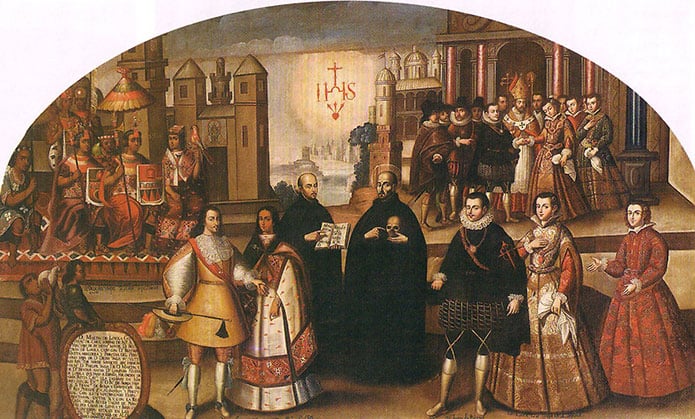
The Viceroyalty of Peru officially began with the ordinance signed by Charles V in Barcelona on November 20, 1542.
At its height it covered a territory stretching from Panama to Tierra del Fuego, except for Venezuela and the part of Brazil that belonged to Portugal.
THE VICEROY
“The other self of the king”, he personified His Majesty, even wearing the same attire. Viceroys were chosen from the Spanish nobility, army and clergy. The king, on the advice of the Council of the Indies, appointed them for a term of years that was often extended.
They sailed from Seville or Sanlúcar de Barrameda to Portobelo and then went to Panama. From there they sailed to Paita and continued by land to Lima.
From 1613 viceroys had to write their Memoirs, and before returning to Spain they underwent a “juicio de residencia”, a review in which they had to account for their actions in office.
THE ROYAL AUDIENCIA OF LIMA
After the viceroy, it was the highest authority. Its main function was to establish the rule of law and consolidate royal authority.
The Audiencia sought a certain balance of power, as it oversaw the state bureaucracy, starting with the viceroy himself.
The Viceroyalty of Peru included the following audiencias: Panama (1535), Lima (1542), Santa Fe de Bogotá (1549), Charcas (1559), Quito (1563), Chile (1609) and Buenos Aires (1661).
THE CORREGIDORES
They held the highest authority in the towns: they presided over the meetings of the town council, kept public order and oversaw the management of municipal funds. There were corregidores in Peru from 1565 to 1784.
CORREGIMIENTOS OF PERU (16TH AND 17TH CENTURIES)
Cusco, Cajamarca, Saña and Chiclayo, Arica, Collaguas, Andes del Cusco, Ica, Arequipa, Huamanga, Piura and Huancavelica.
THE INTENDANCIES
They replaced the corregimientos because of the corregidores’ abuses, after the rebellion of Túpac Amaru II, from 1784.
Intendancies and their districts (partidos):
TRUJILLO
Piura, Saña, Chachapoyas, Cajamarca, Trujillo, Huamachuco, Pataz.
TARMA
Conchucos, Huaylas, Huamalíes, Huánuco, Cajatambo, Jauja.
LIMA
Santa, Chancay, Canta, Huarochirí, Lima, Yauyos, Cañete, Ica.
HUANCAVELICA
Tayacaja, Huancavelica, Angaraes, Castrovirreyna.
HUAMANGA
Huanta, Huamanga, Anco, Cangallo, Andahuaylas, Lucanas, Parinacochas.
AREQUIPA
Condesuyos, Camaná, Collaguas, Arequipa, Caylloma, Arica.
CUSCO
Urubamba, Abancay, Calca y Lares, Aymaraes, Cotabambas, Cusco, Paucartambo, Paruro, Quispicanchis, Chumbivilcas, Tinta.
PUNO
Carabaya, Lampa, Azángaro, Paucarcolla, Chucuito.
The Viceroys of Peru
Viceroys under the House of Habsburg
REIGN OF CHARLES I (1517-1556)
- I. Blasco Núñez de Vela (1544-1546)
- II. Antonio de Mendoza (1551-1552)
- III. Andrés Hurtado de Mendoza, Marquis of Cañete (1556-1561)
REIGN OF PHILIP II (1556-1598)
- IV. Diego López de Zúñiga, Count of Nieva (1561-1564)
- V. Lope García de Castro (1564-1569), who governed with the title of governor only
- VI. Francisco de Toledo (1569-1581)
- VII. Martín Enríquez de Almansa (1581-1583)
- VIII. Fernando de Torres y Portugal, Count of Villar Don Pardo (1585-1589)
- IX. García Hurtado de Mendoza, Marquis of Cañete (1589-1596)
REIGN OF PHILIP III (1598-1621)
- X. Gaspar de Zúñiga y Acevedo, Count of Monterrey (1604-1606)
- XI. Juan de Mendoza y Luna, Marquis of Montesclaros (1607-1615)
- XII. Francisco de Borja y Aragón, Prince of Esquilache (1615-1621)
REIGN OF PHILIP IV (1621-1665)
- XIII. Diego Fernández de Córdoba, Marquis of Guadalcázar (1622-1629)
- XIV. Luis Jerónimo Fernández de Cabrera y Bobadilla, Count of Chinchón (1629-1639)
- XV. Pedro de Toledo y Leiva, Marquis of Mancera (1639-1648)
- XVI. García Sarmiento de Sotomayor, Count of Salvatierra (1648-1655)
- XVII. Luis Enríquez de Guzmán, Count of Alba de Liste (1655-1661)
- XVIII. Diego de Benavides y de la Cueva, Count of Santisteban (1661-1666)
REIGN OF CHARLES II (1665-1700)
- XIX. Pedro Fernández de Castro, Count of Lemos (1667-1672)
- XX. Baltasar de la Cueva Enríquez, Count of Castellar (1674-1678)
- XXI. Melchor de Liñán y Cisneros, Archbishop of Lima (1678-1681)
- XXII. Melchor de Navarra y Rocafull, Duke of La Palata (1681-1689)
- XXIII. Melchor Portocarrero Lasso de la Vega, Count of La Monclova (1689-1705)
Viceroys under the House of Bourbon
REIGN OF PHILIP V (1700-1746)
- XXIV. Manuel de Oms y de Santa Pau, Marquis of Castelldosrius (1707-1710)
- XXV. Diego Ladrón de Guevara, Bishop of Quito (1710-1716)
- XXVI. Diego Morcillo Rubio de Auñón, Archbishop of Charcas (1716)
- XXVII. Carmine Nicolás Caracciolo, Prince of Santo Buono (1716-1720)
- XXVIII. José de Armendáriz, Marquis of Castelfuerte (1724-1736)
- XXIX. José Antonio de Mendoza Caamaño y Sotomayor, Marquis of Villagarcía (1736-1745)
REIGN OF FERDINAND VI (1746-1759)
- XXX. José Antonio Manso de Velasco, Count of Superunda (1745-1761)
REIGN OF CHARLES III (1759-1788)
- XXXI. Manuel de Amat y Junyent (1761-1776)
- XXXII. Manuel de Guirior (1776-1780)
- XXXIII. Agustín de Jáuregui y Aldecoa (1780-1784)
- XXXIV. Teodoro de Croix (1784-1790)
REIGN OF CHARLES IV (1788-1808)
- XXXV. Francisco Gil de Taboada y Lemos (1790-1796)
- XXXVI. Ambrosio O’Higgins, Marquis of Osorno (1796-1801)
- XXXVII. Gabriel de Avilés, Marquis of Avilés (1801-1806)
REIGN OF FERDINAND VII (1808-1833)
- XXXVIII. José Fernando de Abascal, Marquis of La Concordia (1806-1816)
- XXXIX. Joaquín de la Pezuela, Marquis of Viluma (1816-1821)
- XL. José de la Serna, Count of Los Andes (1821-1824)
Population of Peru in 1792, by intendancy
| Trujillo | 320,967 |
| Cusco | 216,282 |
| Tarma | 201,259 |
| Lima | 149,112 |
| Arequipa | 136,175 |
| Huamanga | 111,460 |
| Huancavelica | 30,917 |
Advertisement