
Peru is located in the central and western part of South America. Because it lies south of the Equator, it belongs to the Southern Hemisphere.
AREA
1,285,216.63 km², making it the third-largest country in South America.
Its coastline, from the Capones channel on the border with Ecuador to the point where the Concordia line meets the Pacific Ocean on the border with Chile, is approximately 3,080 kilometers long.
The total perimeter of Peru, including its land borders and coastline, is 10,153 kilometers.
POPULATION
About 34 million inhabitants.
FORM OF GOVERNMENT
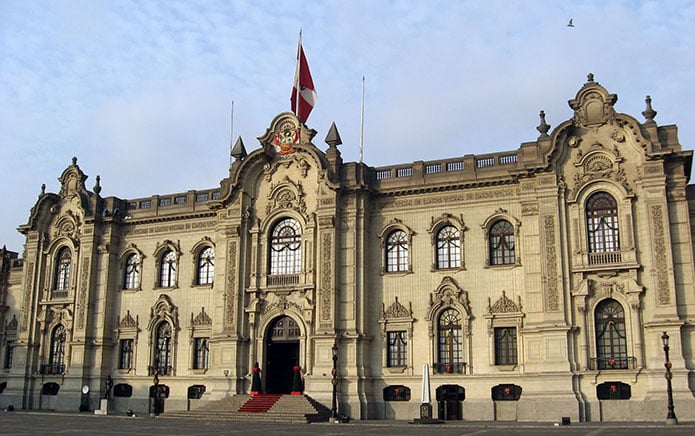
According to the Political Constitution of Peru, the Republic of Peru is democratic, social, independent and sovereign; the State is one and indivisible; and its government is unitary, representative and decentralized, organized according to the principle of the separation of powers.
The President of the Republic is elected every five years in general elections. See our article Presidents of Peru for the complete list.
POLITICAL DIVISION
Peru is divided into 24 departments (regions) and one constitutional province, Callao.
NATURAL REGIONS
Traditionally Peru is divided into three main regions: the coast (11% of the country), the highlands (32%) and the jungle (57%).
In 1941, Javier Pulgar Vidal proposed a division into eight natural regions, which became the most widely accepted and used. Another interesting proposal is that of Antonio Brack Egg, who identified eleven ecoregions to fill the gaps in Pulgar Vidal’s model.
LANGUAGES
Besides Spanish, Quechua and Aymara are spoken, as well as more than forty native languages, mainly in the jungle.
Advertisement