
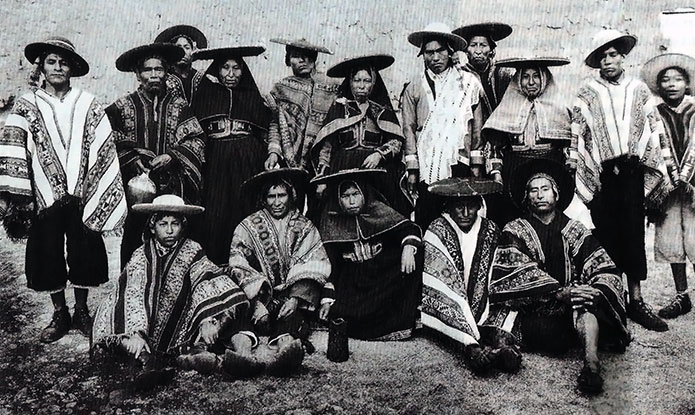
Peru has been a multilingual country since pre-Hispanic times. On the north coast, in the area of the Chimú Kingdom, several languages were spoken: Sec (in Tumbes and Piura), the Pescadora language (in Pacasmayo and Guadalupe), Muchic or Yunga (from Motupe to Chicama) and Quingnam (Moche, Virú and Chao valleys).
Culle was spoken in Cajamarca, Cajabamba and Huamachuco; Puquina in Arequipa, Moquegua, Tacna and Puno; and the Aru languages in the central and southern highlands.
The greatest linguistic diversity today is in the Amazon.
Quechua
Quechua was the language of the Incas, but its origins have been traced to the central coast and highlands of Peru, some two thousand years before the Spanish conquest. In the Inca Empire it was called “runa simi”, “the language of the people”. The name Quechua was given by the Spanish: “qhichwa” meant the temperate valley zone between about 2,300 and 3,500 meters above sea level, and the conquistadors used the name for the language spoken by the people living there.
In colonial times Quechua was very useful for converting the indigenous population to Christianity. Because priests needed to know it, a chair of Quechua was created at the University of San Marcos in Lima in 1577.
Today it is spoken from southern Colombia to northern Argentina, across the highlands of Ecuador, Peru and Bolivia, by an estimated eight to ten million people. In Peru, several million people speak it as their mother tongue, and it is an official language.
Varieties of Quechua in Peru (according to Inés Pozzi-Escot)
- Northern Quechua
- Central Quechua
- Pacaraos Quechua
- Southern Quechua
- Amazonian (Jungle) Quechua
A Quechua poem. This harawi (love song) comes from the colonial drama Ollantay, one of the great works of Quechua literature. In it, a lover sings of his lost “dove”, a woman named Star, whose beauty is compared to the sun, the moon and the rainbow:
Urpi uywayta chinkachikuni
Huk ch’imlliyllapi.
Paqta rikuwaq, tapukuypuni
Kay k’itillapi.
Millay munaymi sumaq uyanpi,
Quyllur sutinmi. […]
Aymara
Aymara is the second most widely spoken indigenous language in Peru. It belongs to the Aru (or Jaqi) language family, which also includes Jaqaru and Kawki, still spoken in the province of Yauyos, in the highlands of Lima.
Aymara and Quechua have influenced each other deeply over many centuries and share a great deal of vocabulary. The origins of the Aru languages are thought to lie in the central Andes (between Huarochirí, Yauyos, Cañete and Nasca), from where they spread south to the Altiplano.
In the past it was spoken around Lake Titicaca by peoples such as the Canchis, Canas, Collas, Lupacas, Pacajes, Carangas and Charcas. Today it is spoken by some two million people in Peru, Bolivia and Chile, including several hundred thousand in Peru, mainly in Puno, Moquegua and Tacna. It is also an official language. Modern writers such as the Puno poet José Luis Ayala have written poetry in Aymara.
The Peoples and Languages of the Amazon
The linguist Inés Pozzi-Escot identified 16 language families in the Peruvian Amazon and around 40 ethnolinguistic groups, or indigenous peoples. Among the largest are the Asháninka, the Awajún (Aguaruna), the Shipibo-Konibo, the Shawi (Chayahuita), the Kukama-Kukamiria, the Matsigenka, the Wampis (Huambisa), the Yanesha, the Ticuna and the Achuar.
Main language families
1. Arawak. Spoken in Peru, Paraguay, Bolivia, Brazil, Colombia, Venezuela, Guyana and Central America. In Peru it includes the languages of the Asháninka, Yanesha, Matsigenka and Nomatsigenga.
2. Jivaroan. The Jivaroan peoples live in the northeastern Amazon of Peru and Ecuador; they include the Achuar, Awajún, Wampis and Shuar. The extinct Bracamoros of the Jaén region belonged to this family.
3. Panoan. This family is found in Peru and Brazil. Its homeland was probably the upper Ucayali, and today its peoples live in the basins of the Yavarí, Ucayali, Purús and Yurúa rivers. Panoan languages include Amahuaca, Capanahua, Cashibo-Cacataibo, Cashinahua, Matsés, Sharanahua, Shipibo-Konibo, Nahua and Yaminahua.
A Shipibo song. In this traditional song, the Shipibo lament that the paiche, a large and delicious fish, is disappearing, wiped out by outsiders, “the great wiracochas”, whose origins they do not know.
Ani yapashaman riqui
noe noe shaman riqui
icashbirrarriqui moa
queyoboai.
4. Cahuapanan. Found only in Peru, in the area of the Cahuapanas River, a tributary of the Marañón. It includes the languages of the Shawi (Chayahuita) and Jebero peoples.
5. Tupi-Guarani. These languages are spoken in much of Brazil, Paraguay, Peru and Argentina. In Peru, the Kukama-Kukamiria and Omagua peoples belong to this family.
6. Peba-Yagua. Another family found mainly in Peru. Its only surviving language is that of the Yagua people, along the Amazon near the border with Brazil.
7. Witotoan. This family is originally from Colombia. During the rubber boom these peoples were forced from their lands. In Peru the Huitoto and Ocaina speak languages of this family.
8. Harakmbut. It is found along the Madre de Dios River. Its peoples include the Amarakaeri, Arasaeri, Huachipaeri, Sapiteri and Toyoeri.
9. Tucanoan. This family is spread across the Amazon of Peru, Brazil, Colombia and Ecuador. In Peru, the Maijuna (Orejón) and Secoya peoples on the border with Colombia speak Tucanoan languages.
10. Zaparoan. Found mainly in Peru and, to a lesser extent, in Ecuador. Its languages are those of the Arabela, Iquito and Taushiro peoples.
11. Tacanan. Its only language in Peru is that of the Ese Eja people, who also live in the Bolivian Amazon along the Beni River.
Advertisement