
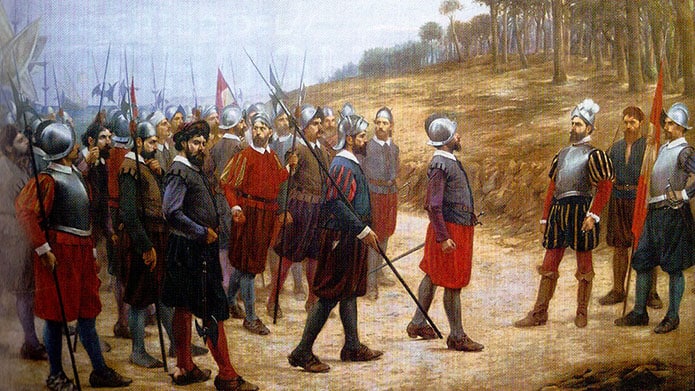
The Spanish first reached Peruvian territory during Francisco Pizarro’s second voyage, in 1527. They sailed along much of the north coast, passing Paita, Sechura and Pacasmayo, as far as the mouth of the Santa River, from where they decided to return to Panama.
After this, Pizarro traveled to Spain. On July 26, 1529, in Toledo, he obtained the Capitulation of Toledo on behalf of the three partners in the conquest, Francisco Pizarro, Diego de Almagro and Hernando de Luque. It granted Pizarro the titles of governor, captain general, adelantado and chief constable of Peru.
With official authorization from the Spanish Crown, they left Panama for Peru on January 20, 1531, with some 180 men and 37 horses. After spending several months on the island of Puná, they landed at Tumbes in 1532.
In 1532 Pizarro founded the first Spanish city in Peru, San Miguel de Tangarará. He then marched to Cajamarca, where the Inca Atahualpa was known to be, arriving on November 15, 1532. A meeting with the Inca was arranged for the next day. On November 16, after a brief exchange in the main square, the Inca was captured and thousands of his people were killed. Atahualpa had come with unarmed attendants, underestimating the military power of the Spanish, who, helped by groups hostile to the Inca, dealt a heavy blow to the Inca forces.
Atahualpa was held prisoner for almost nine months. He had offered to fill one room with gold and two with silver in exchange for his freedom. He was nevertheless deceived and executed in the main square of Cajamarca on July 26, 1533. He was first sentenced to be burned at the stake, but because he accepted baptism, the sentence was changed to death by garrote. The Spanish shared out an enormous treasure, of which a fifth (the “royal fifth”) went to the Spanish Crown.
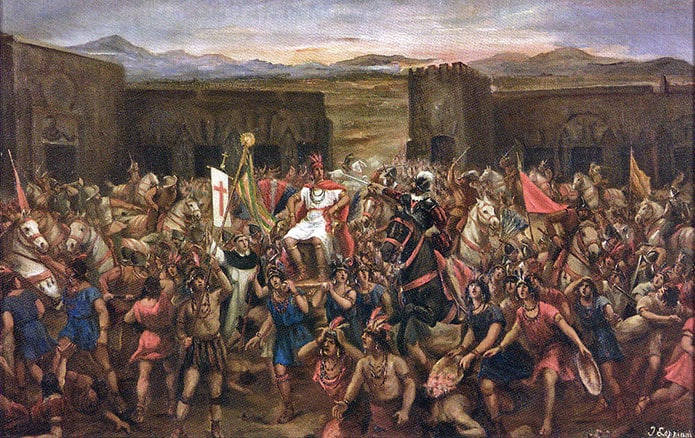
Pizarro then set off for Cusco on August 11, 1533. On the way, at Jaquijahuana, he was met by Manco Inca Yupanqui, son of Huayna Cápac, who claimed the right of succession. Pizarro proclaimed him Inca and Lord of the Four Regions. On November 14, 1533 the Spanish and the new Inca arrived in Cusco, where the people welcomed them joyfully, seeing Pizarro as the avenger of the Inca Huáscar’s death.
Four months later, on March 23, 1534, Pizarro founded Cusco as a Spanish city. Then, on April 25, 1534, he founded Jauja as the capital of his governorship.
When Manco Inca realized the true intentions of the Spanish in Peru, he organized an uprising that led to the siege of Cusco, beginning on May 3, 1536. The fighting ended in favor of the Spanish, who took the fortress of Sacsayhuaman with the support of the Huancas, Cañaris, Chachapoyas, Tarmas, Yauyos and Chancas. A hero of this struggle was the Inca general Cahuide, who chose to throw himself from the top of the fortress rather than be captured.
Another uprising, led by Titu Yupanqui, took place near Lima, but he was defeated and killed.
Meanwhile, Diego de Almagro had failed in his expedition to Chile. Desperate for riches, he seized Cusco and captured Hernando and Gonzalo Pizarro, as well as Alonso de Alvarado, who had come from the Chachapoyas area. On April 6, 1538, Almagro faced Hernando Pizarro at the Battle of Las Salinas, very near Cusco. Diego de Almagro was taken prisoner and executed by garrote.
Almagro’s son, Diego de Almagro “El Mozo” (the Younger), led the Almagrists in their quest for revenge. It was this group that murdered Francisco Pizarro in Lima on June 26, 1541. El Mozo’s fate was sealed: he was captured and executed by the forces of Cristóbal Vaca de Castro, sent by the King of Spain to restore order.
The Viceroyalty of Peru was established on November 20, 1542, and Blasco Núñez Vela was appointed its first viceroy. He was defeated and killed near Quito by the rebels led by Gonzalo Pizarro.
The Crown then sent Pedro de la Gasca, whose mission was to capture Gonzalo Pizarro. He succeeded at the Battle of Jaquijahuana on April 9, 1548. Gonzalo Pizarro was beheaded and buried in the Church of La Merced in Cusco where, as fate would have it, he lies beside two of his enemies, Diego de Almagro and his son, El Mozo.
Advertisement