
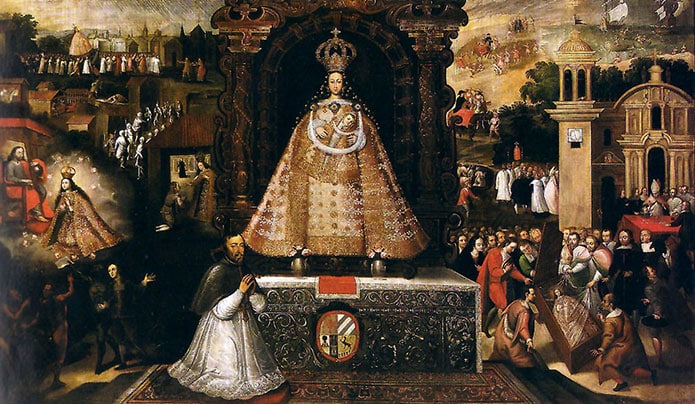
The Cusco School flourished in the late 17th century and much of the 18th. Its great promoter was the Bishop of Cusco, Manuel de Mollinedo y Angulo, who arrived in 1673. His project was to rebuild the churches damaged by the earthquake of 1650, which included completely redecorating the cathedral.
A characteristic of the Cusco School is that its landscapes are not Andean, but idealized, paradise-like backgrounds with seas or forests.
The clothing of the figures is decorated with fine lines of gold leaf (brocateado). A Cusco creation is the depiction of archangels carrying harquebuses; the harquebus was associated with the sound of thunder, which had been worshipped as a god in the Andes.
The school was so successful that by the second third of the 18th century the workshops were producing religious paintings in series. Its works spread from Santiago de Chile and La Plata to Trujillo and Cajamarca, and sometimes as far as Mexico.
The Italian Masters
Three Italian painters who worked in Peru had a decisive influence on the painting that led to the Cusco School.
Bernardo Bitti (1548-1610)
He was a painter and a Jesuit. He arrived in Peru in 1575. His style was Mannerist, with elongated figures and soft colors. His masterpiece is the “Coronation of the Virgin”, displayed in the church of San Pedro in Lima. In 1592 he met Mateo Pérez de Alesio, who influenced his painting of Madonnas.
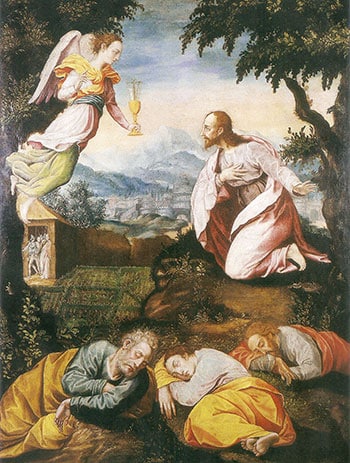
Mateo Pérez de Alesio (1547-c. 1616)
He arrived in Lima in 1588. His most famous painting is the “Virgin of the Milk”, one of whose replicas was venerated by Saint Rose of Lima and is still kept in her sanctuary. Before coming to Peru, in 1572, he painted a fresco in the Sistine Chapel, “The Dispute over the Body of Moses”.
Angelino Medoro (1567-1633)
Before coming to Peru he worked in Bogotá, Cali and Quito. He was in Lima from about 1600 to 1620, where he painted the “Immaculate Conception” (1618) for the convent of San Agustín. He was a friend of Saint Rose of Lima and painted her portrait shortly after her death.
The Indigenous Masters
Diego Quispe Tito (1611-c. 1681)
He came from a noble indigenous family settled in the San Sebastián neighborhood of Cusco. He painted the series of the signs of the Zodiac (1681) for Cusco Cathedral; only some of the paintings survive, possibly because the artist died before completing it.
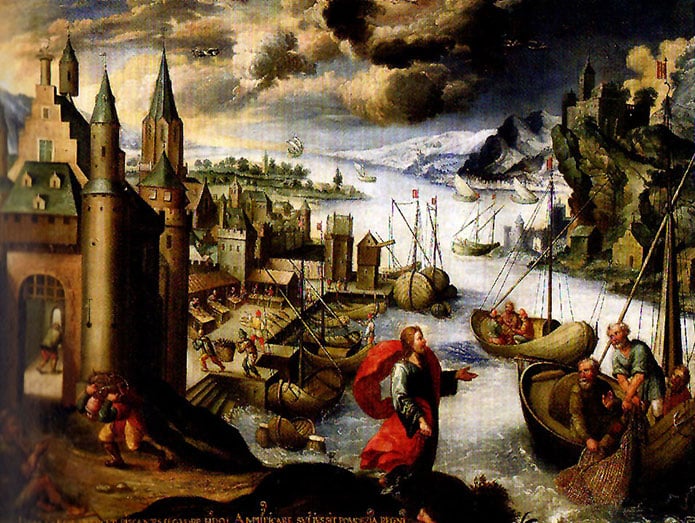
Basilio de Santa Cruz Pumacallao (active 1661-1700)
He worked on the large series on the life of Saint Francis of Assisi for the Franciscan convent in Cusco, a work praised by Viceroy the Count of Lemos. Bishop Mollinedo later chose him to paint important works for the decoration of the Cathedral, where several of his large canvases can still be seen.
Advertisement


