
Taking into account climate, geographic regions, rivers, plants and animals, the renowned Peruvian scientist Antonio Brack Egg identified eleven ecoregions in Peru.
1. The Cold Sea of the Humboldt Current
The first of Peru’s eleven ecoregions stretches from central Chile up to latitude 5° south, in Piura. Its water temperature drops to 13-14 °C (55-57 °F) in winter and reaches 15-17 °C (59-63 °F) in summer.
The water is green because of the abundance of plankton, made up of:
- Phytoplankton: microscopic plants and algae, which are food for the zooplankton.
- Zooplankton: mainly fish eggs and larvae, jellyfish, crustaceans and other small sea creatures.
The cold sea of the Humboldt Current is extremely rich in life thanks to its well-oxygenated water, high concentration of nutrients and abundant sunlight. The nutrients come from “upwelling”, in which deep, nutrient-rich water rises to the surface. This happens along a strip about 1,500 kilometers long and 60 kilometers wide. The most important upwelling areas, the richest and most productive in the Peruvian sea, are off Paita, between Pimentel and Salaverry, between Huarmey and Supe, off Pisco, and between San Juan and Mollendo.
Another advantage of the Peruvian sea is that, being close to the Equator, it receives a lot of solar energy, which favors photosynthesis by green algae. Its salinity ranges between 33.8 and 35.2 grams of salt per liter of water.
About 600 species of fish live in this ecoregion. The most abundant are the sardine and the Peruvian anchovy (anchoveta), which feed many other fish, such as bonito, skipjack tuna, jack mackerel, cojinova, corvina, silverside (pejerrey), lorna, mullet, sea bass, flounder, rays and many more.
There are many species of dolphins, as well as whales, sperm whales and the marine otter. There are two species of sea lion: the South American fur seal and the South American sea lion.
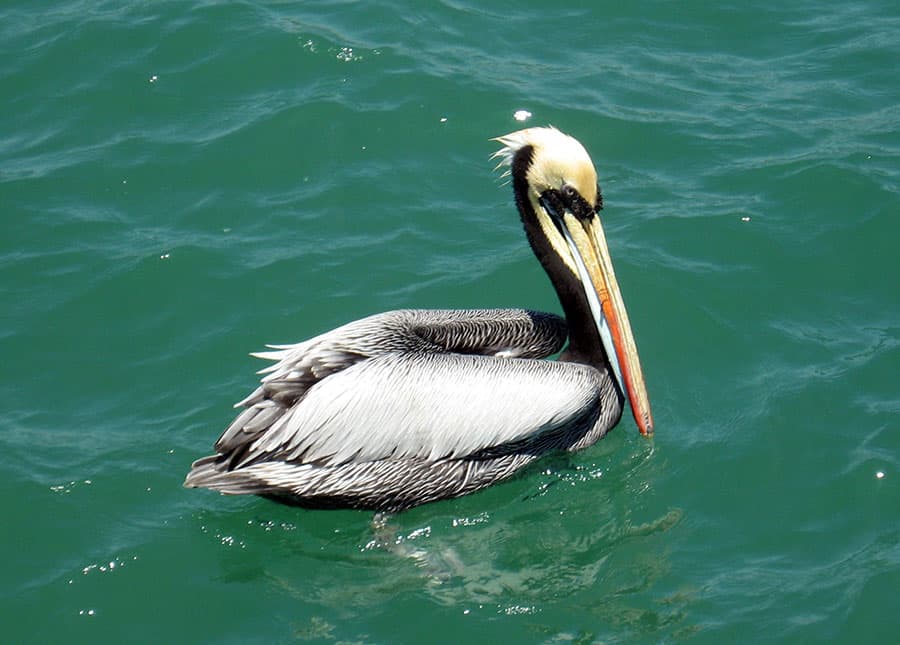
Birds include the Humboldt penguin, the guanay cormorant, the Peruvian booby, the Inca tern, the Peruvian diving petrel and the Peruvian pelican.
2. The Tropical Sea
This ecoregion stretches from latitude 5° south, in Piura, as far north as southern California in the United States. The warm El Niño current has a crucial influence here.
The coasts of Piura and Tumbes are warm all year round: sea temperatures exceed 19 °C (66 °F) and reach over 22 °C (72 °F) in summer. The water is less salty because rains bring in a lot of fresh water. This sea is not rich in nutrients, as there is no upwelling, and it holds less oxygen because of the tropical temperatures.
The main fish include sharks, flying fish, yellowfin tuna, black marlin and skipjack. This is also the home of some of the fish most prized in Peruvian cuisine, such as corvina, grouper (mero) and ojo de uva.
Typical birds are the giant petrel, the cape petrel, the frigatebird, the tropicbird and the blue-footed booby.
This area is ideal for the breeding of humpback whales, which migrate from Antarctic waters and gather here in the southern winter.
At least four species of sea turtle live here; the most common are the green turtle and the leatherback.
The mangroves are also found in this ecoregion. Mangroves grow along the shore: when the tide is low and their roots are exposed, land animals come to look for food, and when the tide rises, sea creatures move in. Fish include snappers, northern anchovy, sea bass and mullet. Black clams (conchas negras), prawns and crabs are abundant. The symbol of this area is the American crocodile, or Tumbes crocodile.
3. The Pacific Desert
The third ecoregion covers the coast from latitude 5° south (Piura) to 27° south (northern Chile), with an average width of about 20 km.
It has almost no rain, and the land is desert. There is vegetation only in the river valleys and on the lomas, hills that turn green in winter (May to October). This only happens on slopes facing the sea, so lomas appear only in certain places along the coast. They are formed by the condensation of the fog that rolls in from the sea; relative humidity is above 80% and reaches 100% in the foggy months. Animals of the lomas include lizards, the gray deer, the Andean fox, the burrowing owl, the puma and the viscacha. The Lomas de Lachay are a good example of their variety.
The rivers of this ecoregion used to be full of freshwater shrimp, but they have now disappeared from almost every valley.
Sand deserts are very common, especially where the wind blows, forming dunes. A symbol of this area is the Huacachina oasis near Ica.
The characteristic trees are the sapote, the algarrobo (carob) and the faique.
4. The Equatorial Dry Forest
This ecoregion stretches from the Gulf of Guayaquil (0° 30′ south) to La Libertad (7° 40′ south). At its widest it reaches 150 kilometers inland and rises to 1,500 meters above sea level.
Its climate has a long dry season that can last nine months of the year.
The equatorial dry forest also reaches inland, along the lower floor of the Marañón valley up to 2,800 meters above sea level.
Its main plant formation is the algarrobo (carob) forest and, in the rainier areas, the ceibo forest; unlike carob trees, ceibos depend directly on the rain.
5. The Pacific Tropical Forest
It runs from the northern tip of Tumbes all the way to Costa Rica. It is covered by evergreen forest, with trees more than 30 meters tall. It is the only part of the Peruvian coast where monkeys live in the wild, with two species: the mantled howler monkey and the white-fronted capuchin. It is also one of the last refuges on the coast for animals such as the collared peccary, the jaguar, the anteater, the American crocodile and the neotropical otter.
6. The Steppe Highlands
The Steppe Highlands ecoregion lies between 1,000 and 3,800 meters above sea level, from the La Libertad region (7° 40′ south) to northern Chile.
Average temperatures range between 6 °C and 12 °C (43-54 °F). The higher you go, the more it rains and the denser the vegetation.
Above 3,000 meters, the most characteristic tree is the Andean alder (aliso).
7. The Puna
Of Peru’s eleven ecoregions, this is the highest. It covers the high Andes above 3,800 meters. Its climate is cold and the sunlight strong.
Ichu is the most widespread grass. The constant wind keeps temperatures low and the air dry.
The vicuña, the viscacha, the Andean fox and the wild guinea pig live here. The taruca, or Andean deer, is the only deer that reaches the highest parts.
8. The Páramo
It stretches from Venezuela through Colombia and Ecuador to northern Peru, where it is found in the Piura and Cajamarca regions, in the upper basins of the Chinchipe, Huancabamba and Quirós rivers (around 3,500 m). It is a very misty area, with night temperatures below 0 °C (32 °F). Its vegetation is similar to that of the puna, but much wetter.
9. The High Jungle (Selva Alta)
This ecoregion runs along the eastern slopes of the Andes, from the border with Ecuador to the border with Bolivia, between 500 and 3,500 meters above sea level.
Its climate is very varied, and rainfall can exceed 3,000 millimeters a year.
Trees grow shorter as altitude increases. In the cloud forest (ceja de selva), from about 2,500 to 3,800 meters, trees reach only about 15 meters, and the humidity allows epiphytes, or air plants, to grow in abundance, not only on the trees but also on the ground.
10. The Lowland Rainforest (Selva Baja)
It covers the Amazon forests below about 600 meters. The land is fairly flat, and the average temperature is 24-26 °C (75-79 °F). The heat and humidity support the greatest diversity of species.
Most of the wildlife lives in the treetops, and less on the shady forest floor.
Lakes, streams and swamps are abundant. Giant river otters live here, as well as the paiche (arapaima), the largest fish in the Amazon. Other typical animals are monkeys, sloths, parrots and macaws, the harpy eagle and boas.
11. The Palm Savanna
This is the smallest ecoregion, covering a small area of the Madre de Dios region, on the Pampas del Heath. There are few trees, mainly palms, especially the aguaje. The savanna floods in the rainy season, and fires are common in the dry season.
Advertisement