
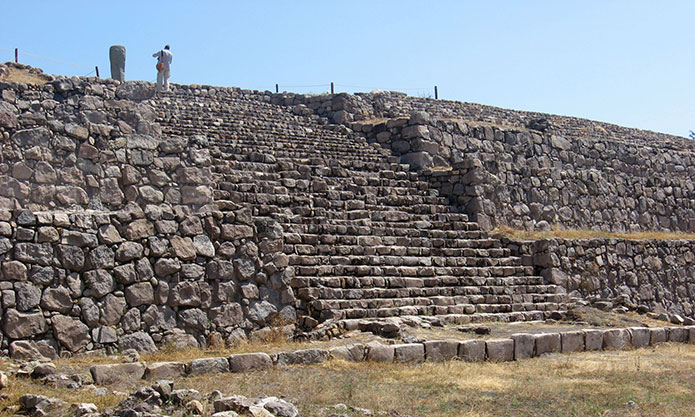
Kuntur Wasi is an archaeological site on La Copa hill in the province of San Pablo, about 115 km from the city of Cajamarca and only 2 km from the town of San Pablo.
It was Julio C. Tello who named it Kuntur Wasi (Temple or House of the Condor), after the images of this bird carved on the stone sculptures found at the site. It covers an area of about 800 by 500 meters.
BACKGROUND
In June 1946, Dr. Tello organized an expedition to the district of San Pablo to explore the ruins of La Copa, where, according to Lima newspapers, Alberto de los Ríos had discovered a sanctuary-fortress while traveling through the region.
Its location makes it a link between two culturally and biologically connected regions, the Cajamarca and Jequetepeque valleys, connecting the peoples living along both rivers.
In the 1940s, several stone sculptures were found representing human beings with feline features, as well as a cemetery on the hillside where people of high status were buried. Gold objects were also found.
DESCRIPTION
Before archaeological work began, local people farmed on top of the temple remains. They probably leveled the ground to do so, which caused further damage.
The Japanese Mission led by Yoshio Onuki has carried out the most important work since 1988. The construction of the temple can be divided into the following phases:
Ídolo phase (950-800 BC)
Kuntur Wasi phase (800-550 BC)
Copa phase (550-250 BC)
Sotera phase (250-50 BC)
Kuntur Wasi has an overall U-shaped layout open to the northeast, with clear similarities to the Huaca de los Reyes in the Moche Valley.
In 1989 the archaeologists found the burials of high-ranking individuals: four in the atrium of the central platform, one in a room on a secondary platform northeast of the central platform, and two in the central plaza.
The burials are thought to have been made just before the central platform of the Kuntur Wasi phase was built, possibly as part of a ritual linked to the construction of the U-shaped complex. Onuki suggests that the tombs may be reburials of people who died on the coast.
OTHER DISCOVERIES
To the monoliths found in the 1940s, the Japanese team added three more. The statues represent supernatural beings: feline-men wearing loincloths tied with a cord.
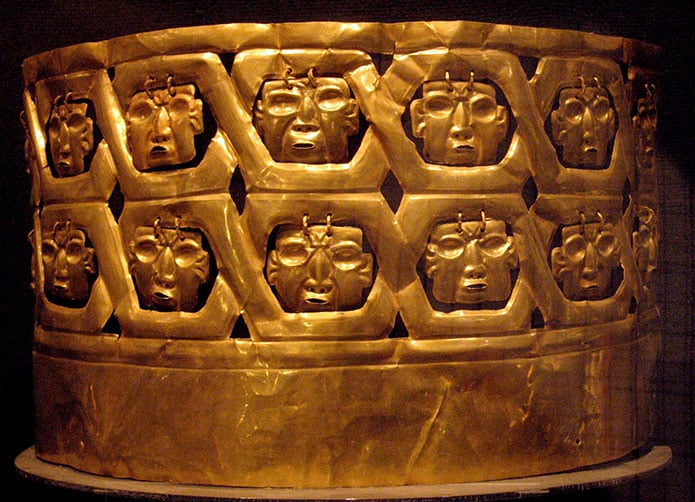
The metal objects uncovered by Yoshio Onuki’s team have been assigned to the Kuntur Wasi phase. They are similar to those of Chongoyape, and both collections are among the oldest examples of metallurgy in Peru.
The techniques used were basically hammering the metal into sheets and embossing. The thin gold sheets were bent into the desired three-dimensional shape, and the edges were then joined by soldering.
According to Rebeca Carrión, the statues resemble those of San Agustín in Colombia, for example in having reliefs on two sides. This may show a dual personality of the god for certain functions, a kind of “double” of the main deity, or the skin of a sacred animal such as a puma, jaguar or lizard worn as a headdress, giving its wearer a more mythical character.
Very close to the archaeological site is the Kuntur Wasi Site Museum, which displays valuable objects found during the excavations directed by Yoshio Onuki.
Advertisement


