
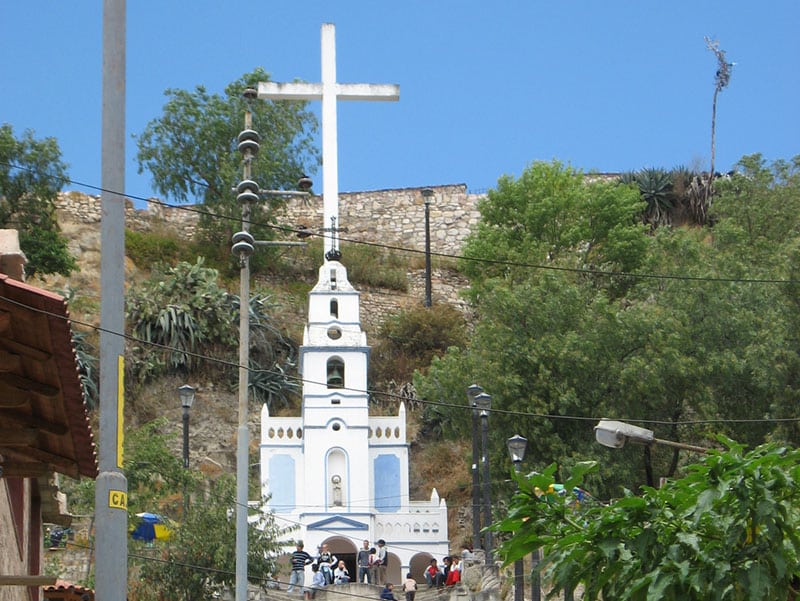
Santa Apolonia hill rises to 2,764 m (9,068 ft) above sea level, only 200 meters from the Plaza de Armas of Cajamarca, and is the city’s natural viewpoint. It is an outcrop of whitish, relatively soft volcanic tuff from the Tertiary period. The earliest occupation of the hill dates from the Torrecitas phase (1200 BC), when its summit was modified with a platform and some underground structures that seem to have been tombs.
From the 7th century BC and throughout the Cajamarca civilization, the hill was devoted to the cult of the dead. Tombs of important people were built here, and the site remained sacred. By the late 14th century, before the Inca conquest of Cajamarca, the hill had become a fortification: it was walled and cut back in several places along its slopes, and some low structures stood on its summit. It was probably a platform with a shrine containing several underground chambers. This is how the Spanish found it. It is said that the shrine of the Serpent stood here, which the Incas respected and added to their pantheon.
Around 1560 the Franciscan friars began to dismantle it, using the stone to build their church and convent. In 1571 a chapel dedicated to Saint Apollonia was built on the summit. The present chapel is dedicated to Our Lady of Fátima and was built in 1954.
The so-called Inca’s Seats (Sillas del Inca) are two carved stones, probably made during the Cajamarca culture as altars for agricultural rituals. After visiting the hill, you can shop for handicrafts in the stores on Calle Dos de Mayo.
Advertisement


