
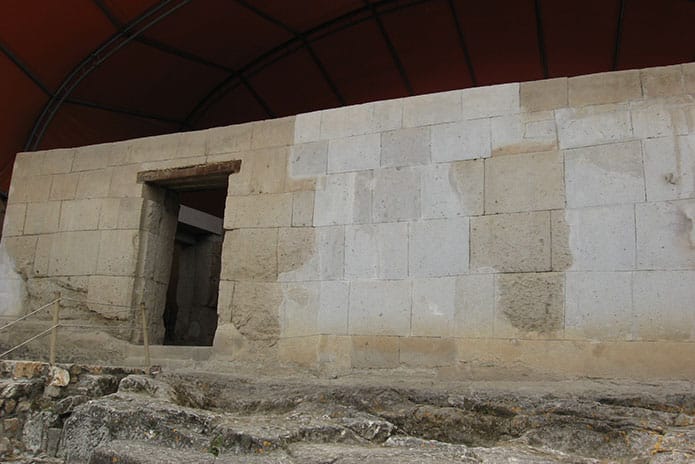
The Ransom Room (Cuarto del Rescate) is located in the historic center of Cajamarca, half a block from the Plaza de Armas, at Jr. Amalia Puga 722.
It is a rectangular building measuring 11.80 meters long by 7.95 meters wide at its base, and 3.10 meters high on the outside.
According to the archaeologist Rogger Ravines, its walls rest directly on the volcanic tuff, without foundations. They are made of polygonal stones of various sizes, worked on all sides and laid dry in courses that look regular though not entirely straight, each stone filling the full width of the wall. Most of the stones are almost square, as tall as they are wide.
History
On the afternoon of November 15, 1532, the Spaniards led by Francisco Pizarro arrived in Cajamarca. There were 168 of them, and they knew that the Inca Atahualpa was here.
On November 16 the Inca was captured and locked up in a house. Julio C. Tello described the setting of the Ransom Room as follows:
In the center of old Cajamarca there was a large walled square about 400 meters long and 200 meters wide. Inside it were three buildings with eight rooms each, arranged around a courtyard with a water reservoir in the center fed by stone pipes. On this side of the wall, within what is now the grounds of the church of San Francisco, rose a temple like a castle or fortress, which the Spaniards called the “Inca’s fortress”: a tall, truncated square pyramid with a double stairway, its upper platform protected by a low wall. This must have been one of the most venerated and ancient monuments of the region, built to worship Casha, an idol in the shape of a serpent or monstrous dragon, the totem of the first inhabitants of Cajamarca. The so-called Ransom Room is what remains of one of those buildings.
The Spanish chroniclers highlighted several features of Cajamarca: the Ushnu, the House of the Serpent, the Acllahuasi, the Colcas (storehouses) and some lodgings divided into eight rooms with stone walls. According to tradition, it was in one of these rooms that Atahualpa offered his ransom.
After those tragic events, these lots passed to the curacas (chiefs) of Cajamarca, who claimed legitimate ownership and inheritance rights.
Horacio Villanueva traced the owners of the site: the Jatuncancha, where the Ransom Room stood, belonged in 1562 to the chief Pedro Angasnapon and his wife Magdalena Casachup. They had two sons, Diego Astopilco and Sebastián Ninalingon, founders of the two branches of the chiefs of Cajamarca. Diego’s descendant Francisco Astopilco had a son, Fernando, who was succeeded by his son Nicolás, married to María Gutiérrez y Sanchón. As a widow, she sold part of the Inca’s lot to the Bethlemite friar José de la Cruz on December 3, 1756.
The site was donated to the Cajamarca Public Charity by a deed dated July 22, 1898. From the early 20th century until 1953 it was part of the Belén Orphanage.
The present entrance was built in 1952 to a design by José Sabogal. Shortly before, the adobe walls that surrounded it had been removed because they were badly deteriorated.
While it belonged to the orphanage, its walls were plastered and it was used as a classroom. A door was opened in the south wall to connect it with the orphanage dining room, two windows were opened in the east wall and the original doorway was widened.
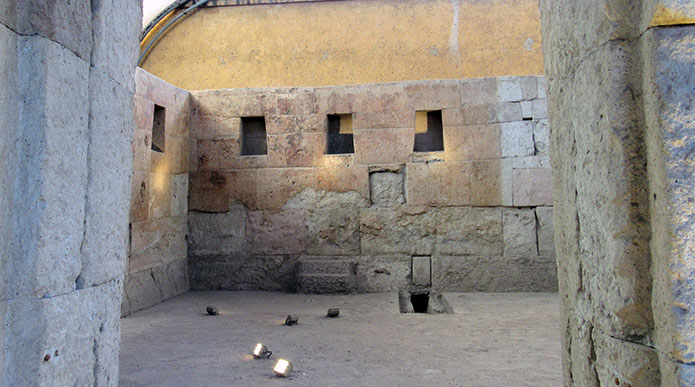
In 1953 the Provincial Municipality of Cajamarca carried out restoration work to return it to its original form. It was separated from the building it was attached to, and an entrance was opened on Jr. Amalia Puga. The brick floor was replaced with stone, although it had been lowered by about 80 cm long before. The second floor, which the Charity had built as a dormitory for the girls, was demolished.
As for the line drawn on the wall to mark how high the room was to be filled with gold, the chroniclers disagree: some say it was white and others red.
Advertisement


