
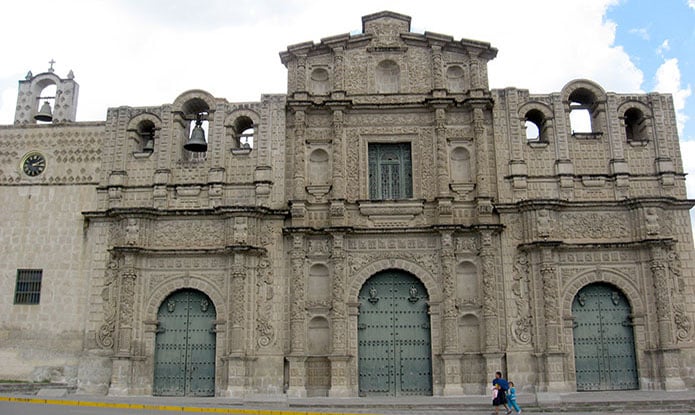
This complex is the finest example of colonial art in Cajamarca. It is made up of the Church of Belén, the Men’s Hospital and the Women’s Hospital.
Church of Belén
The church was built with funds from the corregidor (royal administrator) Francisco de Espinoza. The work was directed by the master builder José de Morales, who completed it in 1744.
Like the other churches of Cajamarca, its façade is carved like an altarpiece. It has three tiers with niches holding different sculptures.
At the very top, on a wavy cornice, are three sculptures representing the three theological virtues: FAITH, in the center, blindfolded (“blind faith”) and holding a chalice; HOPE, on the left, with her symbol, the anchor; and CHARITY, on the right, with a child in her arms. The message was that people should come here with faith and hope to receive charity.
At the entrance is a small chapel that now holds the image of Saint Barbara, though it was originally dedicated to Saint Sebastian. On the altar is a casket with bone fragments and relics of Saint Sebastian, brought by Friar Rodrigo de la Cruz, founder of the hospital.
Inside, the diamond-pattern decoration and the polychrome pendentives stand out. Here you can see angels with raised hands that seem to hold up the drum of the dome. The main altar is relatively modern, Neoclassical, from the mid-19th century; the original did not survive.
Around 1960 the paint was stripped from the walls, and the Baroque colors were lost.
Men’s Hospital
It was built in the 18th century on a Latin-cross plan. Its rooms are very narrow alcoves, now closed off with clear glass. At the entrance there is a re-creation showing how the patients lay: all facing the altar, so they could follow Mass.
The altar, which still keeps part of its murals, holds the image of Our Lady of Mercy (Nuestra Señora de la Piedad). The pendentives show four-winged angels: two wings lift the angel and the other two gather up the soul of the dying.
To the right of the entrance, in the rooms that were once the kitchen, bakery and pantries, is an art gallery dedicated to the Cajamarca painter Andrés Zevallos.
Women’s Hospital
It was built between 1764 and 1767; the bell gable dates from the 19th century. Its Baroque portal has very unusual decoration, notably figures of women with four breasts, probably a symbol of fertility.
As in the Men’s Hospital, the cubicles line each side of the hall, which is covered by a barrel vault. Inside is an archaeological museum displaying ceramics, textiles and other remains from the Cajamarca area.
Advertisement


