
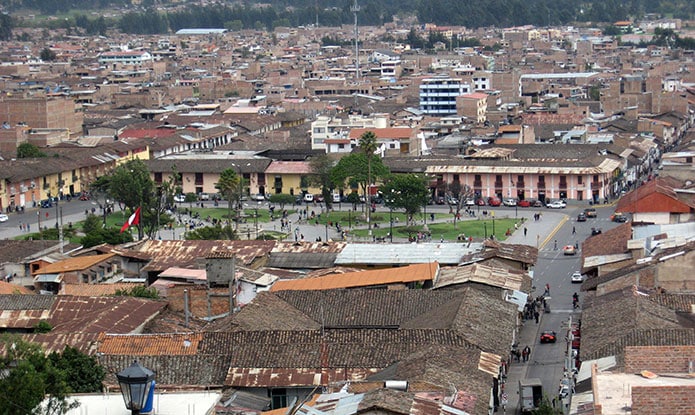
Cajamarca has a population of about 300,000. Like Arequipa, it is one of the cities with the most farmland, and its countryside is home to the largest cattle population in Peru, so milk and dairy products are among its most important activities. Mining is another source of income, with the Yanacocha gold mine.
Cajamarca has a very pleasant climate, as it lies at 2,700 m (8,860 ft) above sea level. It is the city where two worlds met, because it was here that Francisco Pizarro and the Inca Atahualpa first came face to face. The Ransom Room and the Baños del Inca (Inca Baths) survive from that time.
Cajamarca’s attractions are very varied. In the historic center you can visit the stone churches and the Ransom Room. In the surroundings are the Cumbemayo canal, the Ventanillas de Otuzco, the Baños del Inca, the Porcón community, La Collpa and Llacanora.
In February, Cajamarca celebrates Carnival, its traditional festival and the one most visited by Peruvian travelers. The Cajamarca coplas (folk verses) are famous for their mischievous, humorous lyrics full of double meanings. At night in the Plaza de Armas it is common to see groups of people with drums and flutes singing these coplas at the top of their voices, with new verses added every year. There are parades of comparsas (carnival troupes) and dancers in colorful costumes and masks.
CAJAMARCA REGION
ESTABLISHED: Supreme Decree of February 11, 1855
Confirmed by law: September 30, 1862
CAPITAL: Cajamarca, at 2,750 m (9,020 ft) above sea level
AREA: 35,417.82 km²
PROVINCES (13): Cajamarca, Cajabamba, Celendín, Contumazá, Cutervo, Chota, Hualgayoc, Jaén, San Ignacio, San Miguel, San Marcos, San Pablo and Santa Cruz.
CAJAMARCA PROVINCE
ESTABLISHED: February 12, 1821.
CAPITAL: Cajamarca.
AREA: 4,898.65 km²
DISTRICTS (12): Asunción, Cajamarca, Cospán, Chetilla, Encañada, Jesús, Los Baños del Inca, Llacanora, Magdalena, Matará, Namora and San Juan.
TEMPERATURE: Annual average 13 °C (55 °F); minimum 5 °C (41 °F); maximum 21 °C (70 °F).
HISTORY AND NAME:
It was the Incas who called it Cassamarca or Cachamarca, giving it a new name as they did in many regions. Garcilaso de la Vega insists it should be called Casamarca and not Caxamalca. The name contains two Quechua words: qasa, “frost” (not ice), or kasha, “thorn”; and marca, a suffix the Incas used to refer to the lands belonging to a llacta, or town.
The area may therefore have been named “place of frosts” or “place of thorns”. The valley is indeed prone to frosts, which damage the crops, especially corn. However, Father Reginaldo de Lizárraga says that Cajamarca means “land or province of thorns or thorny cacti”, which also makes sense, as thorny plants are abundant in the region, especially in the valley.
Horacio Villanueva explains that Caja-marca means “town of lightning”, which seems plausible since it would refer to a deity they worshipped.
The accounts of Francisco de Xerez and Pedro Sancho de la Hoz, Pizarro’s secretaries, give the most faithful picture of Cajamarca in Inca times. Xerez described a town of about two thousand households, with two bridges at its entrance over two rivers, and a walled square larger than any in Spain, with two gates opening onto the streets of the town. Around the square stood very long, well-built halls with strong walls and roofs of straw and wood, and lodgings divided into eight rooms, better made than any others, built of finely cut stone, each with its own stone enclosure and gates, and with fountains in the courtyards fed by water brought through channels. Facing the square, on the side towards the countryside, stood a stone fortress reached by a stone stairway.
Very little remains of the city described by Pizarro’s secretary. Yet it was here, on the afternoon of November 15, 1532, that a group of Spaniards led by Pizarro entered Cajamarca, and shortly afterwards captured the Inca Atahualpa.
Advertisement


