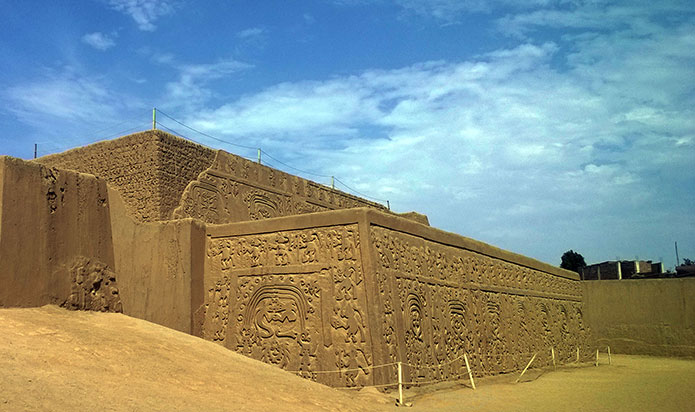
Located in the district of La Esperanza, beside the Pan-American Highway North, this temple belongs to the Chimú culture. It has been known by different names: Huaca Cientopies (Horkheimer, 1944) and El Dragón, “the Dragon” (Schaedel, 1948). Traces of yellow paint can still be seen on some reliefs, which is why it was also called the Huaca of the Golden Wall. However, the most widely used name is Arco Iris, “Rainbow”.
The temple is surrounded by a perimeter wall measuring 60 by 54 meters. Its only entrance faces west. Its decoration was dedicated to the rainbow as a symbol of fertility and rain, which appears seven times on one of the temple walls. Beneath each rainbow is a pair of serpents: one has two heads and the other ends in a fish tail, perhaps representing the two sexes, female and male. The two-headed serpent can also be seen holding a tumi, or ceremonial knife. This recurring animal is linked to other cultures, for which it was a symbol of water and the fertility of the land.
The upper part of the wall shows dancers in motion, facing the entrance. Around the main platform there are 14 storerooms where evidence of offerings and wooden sculptures was found.
Advertisement