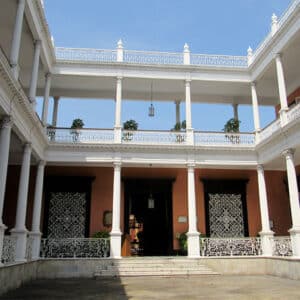
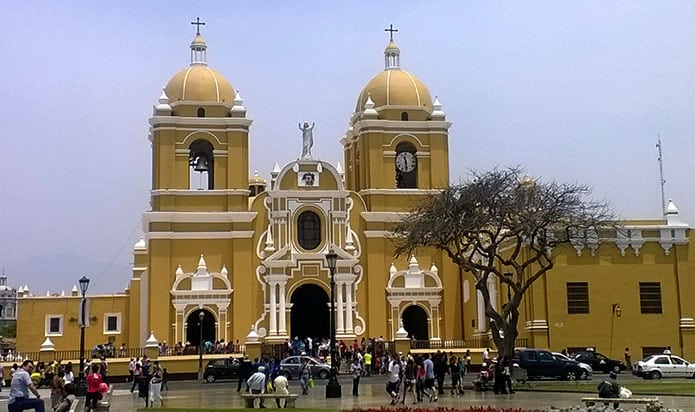
The historic center of Trujillo preserves important religious architecture, especially Baroque churches built of adobe. Trujillo’s churches also keep their artistic treasures: pulpits, altarpieces, choir stalls, glazed tiles and more.
MINOR BASILICA (CATHEDRAL)
A site for the main church was set aside when the city was founded, but the first building was very simple.
In 1616, with the creation of the Diocese of Trujillo, the church became a cathedral, and a building worthy of its rank was erected. Unfortunately, it was destroyed by the earthquake of February 14, 1619. The church was rebuilt between 1647 and 1666. On August 23, 1967, Pope Paul VI, aware of the devotion of the faithful, raised it to the rank of Minor Basilica; the Archbishop of Trujillo at the time was Carlos María Jurgens.
Inside are the oldest altarpieces in Trujillo, those of Saint Peter and Saint John the Baptist (late 17th century), as well as the Main Altarpiece (1721), considered a masterpiece. It follows the old Christian custom of separating the altarpiece from the wall. The first tier holds sculptures of Saint Peter and Saint John the Evangelist, while the second holds the Immaculate Conception with Saint Rose and Saint Valentine, patron saint of Trujillo.
There are also three historic canvases: one shows Saint Toribio de Mogrovejo giving the sacrament of Confirmation (1681) to Saint Rose of Lima; another is the Mystery of the Holy Eucharist, with the Archangel Michael; and finally the Transverberation of Saint Teresa of Ávila.
CHURCH OF LA MERCED
It stands on the fifth block of Jr. Pizarro. The church and convent of La Merced were founded in 1535 by Martín de Novillada and Friar Pedro de Ulloa.
The present church was built after the earthquake of 1619, though it had to be remodeled after damage from another earthquake in 1759.
Its most important features are the beautiful pendentives with polychrome reliefs describing the life of Saint Peter Nolasco. The first shows Christ with the cross receiving the soul of the saint, carried by angels; the second shows the Virgin of La Merced, Christ and Saint Peter Nolasco receiving a blessing. The third is an allegory of the Virgin of La Merced rising to heaven while angels carry her ornaments. Finally, the fourth shows the Mercedarians on a raft, with Saint Peter, children and slaves with chained feet.
The former convent now houses the Superior Court of Justice of La Libertad.
The Order of La Merced (the Mercedarians) was founded by Peter Nolasco in Barcelona on August 10, 1218, and was made official by King James I the Conqueror of Aragon. At first the Mercedarians devoted themselves to ransoming captives held by the Muslims in Spain. Years later, on January 17, 1235, Pope Gregory IX approved and confirmed the Order as an institution for the sanctification of its members, with a clear mission of service to others. As the new order grew and spread, so did devotion to the Virgin of La Merced, or Our Lady of Mercy.
The Mercedarian habit is white and bears the coat of arms of James I: four bars on a gold field, topped by a white cross.
CHURCH OF SAN FRANCISCO
It is located on the corner of Jr. Independencia and Jr. Gamarra. This church was built by the Franciscans, or Seraphic Order. The Christianity they taught the indigenous people was not limited to the catechism: they also trained them in the European way of plowing with oxen, the basics of arithmetic, playing wind and string instruments, and reading and writing Spanish.
Construction was begun in 1536 by Francisco de la Cruz. During Independence, the convent was given to the San Juan National School. When the Franciscans returned in 1894 it was in poor condition, so they finally moved to the church of San Agustín. It later passed to the Carmelite Order.
It is the only church whose north altarpiece has no columns. It has an unusual three-tiered corner tower with an octagonal plan. From its old pulpit, on November 12, 1603, Saint Francis Solano predicted the earthquake of 1619. This saint was born in Spain and was in Trujillo from 1602 to 1604, spending his last years in Lima. His reputation for holiness was such that the canonization process began in the very year of his death. He was beatified in 1675 by Clement X and canonized in 1726 by Benedict XIII.
The images of the Evangelists painted in the transept were made by M. Angelo in 1742. The bronze baptismal font bears the inscription “Francisco Rivas 1670”.
EL CARMEN MONASTERY
It is the most important and beautiful religious complex in northern Peru, belonging to the order of the Discalced Carmelites. Together with Santa Clara, it is one of the only two cloistered convents that have survived. It was the fifth convent founded by the Carmelite Order in Peru, after Lima (December 18, 1643), Cusco (October 22, 1673), Ayacucho (1683) and Arequipa (November 23, 1710).
It was founded on December 6, 1724 by nuns who came from Quito, and had to be rebuilt after the earthquake of 1759. The church is purely Baroque in its plan and elevation. It has a single nave, 30 meters long from the main door to the apse and 10.20 meters wide. The elegant main portal, set between the towers, has two tiers. Its niches hold sculptures of the Virgin of Carmen, Saint Joseph and Saint John of the Cross, crowned by the Carmelite coat of arms. The side portal displays a sculpture of Saint Teresa of Ávila.
The Pulpit
It combines two styles, the result of earthquake damage: the sounding board is Churrigueresque, and the tribune shows French (Rococo) influence. The monastery has a valuable art gallery, which unfortunately is closed. The highlight of the church is the Main Altarpiece, an exceptional work by Fernando Collado, a freed Black slave (1759).
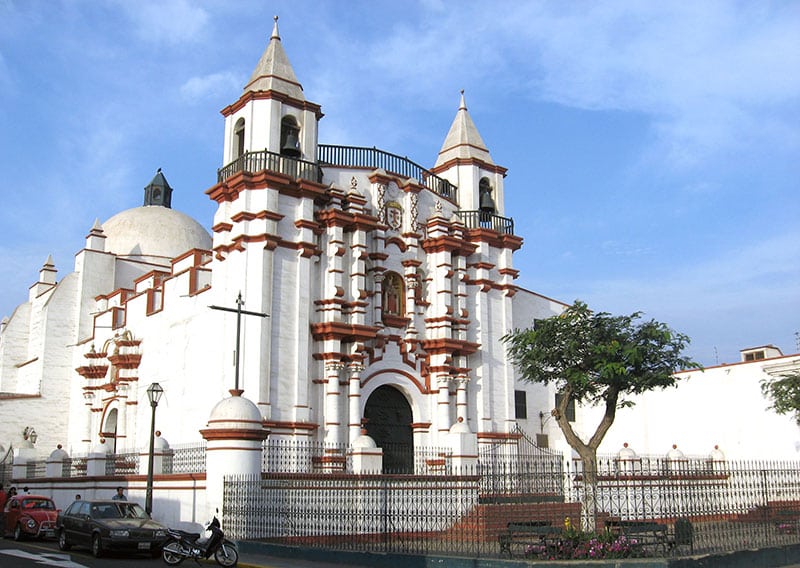
CHURCH AND MONASTERY OF SANTA CLARA
It was founded by Spanish nuns in 1587, with the authorization of Saint Toribio de Mogrovejo, and dedicated to Saint Clare, patron saint of the Franciscan nuns. The church has a Main Altar, with the Crucified Christ in its central niche and a sculpture of Saint Clare in the upper niche; a Baroque altarpiece of Saint Anthony of Padua; and an altarpiece of the Sacred Heart of Jesus, with a single tier and a single section, entirely covered in gold leaf.
Pulpit: on the sounding board is the image of Saint Bonaventure, and on the back, the Immaculate Mother.
Dome: the pendentives have polychrome decoration like those of La Merced, but here they describe scenes from the life of Saint Clare. In the first scene, soldiers enter the town where the Poor Clares, including Saint Clare, were living; on seeing them, the soldiers flee. This is known as the saint’s miracle of saving the town. The second scene shows Saint Francis of Assisi cutting Saint Clare’s hair. Another scene shows the miracle of the loaves.
Advertisement