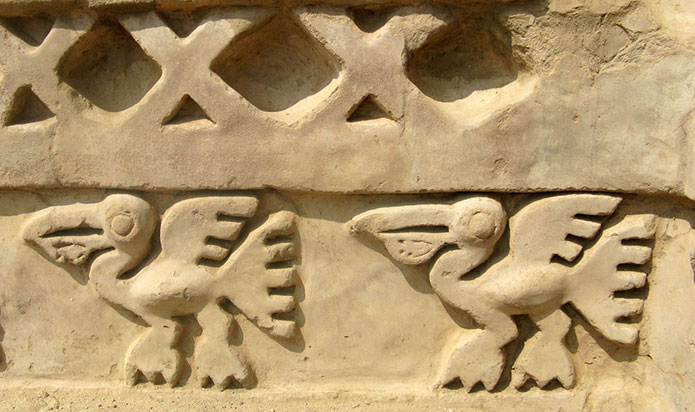
Chan Chan was the political and administrative capital of the Chimú Kingdom. It originally covered more than 20 km²; today it covers only 14 km², and it is considered “the largest adobe city in the world”. On November 28, 1986, UNESCO declared Chan Chan a World Heritage Site.
THE NAME CHAN CHAN
Neither the original name of the city nor whether the name Chan Chan referred to the whole city is known. The first chroniclers do not use this name, but call the place “the City of Chimo”, the name given to the valley, or the Palaces of the Great Chimú.
The name Chan Chan first appears in 1791, in the magazine Mercurio Peruano, referring to this archaeological site. The study of old documents shows that the name Chan Chan belonged to some saltpeter fields near the road to Huanchaco, inside what we now call Chan Chan.
The meaning of Chan Chan as derived from the Muchic “Jang Jang”, “Sun Sun”, comes from Ernst Middendorf (1892). In the opinion of Zevallos Quiñones, the term has no relation to the area, since Quingnam was spoken here. The name Chechengo (1679) may have been the earliest form of the current name.
POPULATION
It is estimated at 20,000 to 30,000 inhabitants (Kent Day), and the population of the whole Chimú territory at 500,000, according to John Rowe. According to Middendorf (1894), 100,000 people lived in Chan Chan. When it was abandoned, the population was probably 5,000 to 10,000 (Kent Day).
ARCHITECTURE
Three types of architecture have been identified at Chan Chan:
1. Monumental architecture
The rectangular walled enclosures, or citadels, which were the residences of the upper class, as well as the huacas, or temples.
2. Intermediate architecture
Adobe buildings where members of the lesser nobility and local chiefs (curacas) lived.
3. Popular architecture
The simplest kind, made of cane and mud and used by artisans.
THE WALLED COMPOUNDS
The city is made up of 10 walled compounds that were given new names, made official around 1945. They share similar features: monumental scale, very restricted access, and complex, elaborate architecture.
Most researchers believe the citadels were palaces with several functions: residences of the elite, administrative areas and, finally, tombs of the Chimú kings.
CONSTRUCTION SEQUENCE
Researchers disagree about the order in which the city was built. Some have suggested that the whole city was built at once (Lanning, 1967), but most propose that it was built and occupied in stages.
Studies have tried to determine the sequence based on architecture, such as U-shaped structures (Andrews, 1972), burial platforms (Pozorski, 1971; Conrad, 1974), the layout of the citadels (Day, 1973) and types of adobe bricks (Kolata, 1978, 1982, 1990). The last has been the most widely accepted and useful.
The construction of Chan Chan can be summarized in three stages:
FIRST STAGE (AD 850-1100)
It begins with the building of the Chayhuac citadel, which has the simplest internal layout, followed by the Uhle citadel, with a more complex plan including administrative offices (audiencias). This shows an economy based on tribute.
SECOND STAGE (AD 1125-1370)
The Laberinto citadel was built, formally establishing the three-part (tripartite) layout of the citadels. The Gran Chimú citadel, the largest in Chan Chan, was also built, with spacious plazas, many storerooms and annexes. This reflects the centralization of political and economic power.
THIRD STAGE (AD 1370-1470)
The citadels became smaller, as did the space for storerooms, showing a decline in tribute. In contrast, the number of state officials and administrators grew considerably, perhaps in an attempt to collect more tribute. However, it was hard to support so many officials during an economic crisis, which weakened any resistance to the Inca threat.
DEATH, POWER AND INHERITANCE
According to Geoffrey Conrad, Chan Chan practiced “split inheritance”. When a ruler died, his heir received only the political office, while the property and income of the deceased passed to a group of his descendants, who acted as administrators, since the dead ruler remained the owner. Each ruler therefore had to build his own citadel, live there with his closest relatives and organize his own administration with new officials. To acquire wealth, he had to conquer new territories.
The citadels were thus sacred places of funerary worship, occupied by people who administered the dead ruler’s income. According to scholars, this practice must have begun during the Chimú expansion, as there is no sign of it in the early stage. The first citadels were probably occupied by more than one ruler.
DECLINE AND ABANDONMENT
When the Spanish arrived in 1534, Chan Chan was abandoned and had lost its political importance. While Huayna Cápac was in Quito, he had to put down a Chimú uprising in Chan Chan, which was harshly crushed. There is evidence that part of the city was burned, and the royal family, led by Huamanchumo, was moved to the village of Mansiche.
THE NIK AN COMPOUND
It is the only compound open to visitors. Between 1964 and 1970, cleaning, consolidation and restoration work was carried out under the direction of the Peruvian Francisco Emilio Iriarte Brenner. In 1972, as part of the Chan Chan-Moche Valley Project led by Michael E. Moseley and Carol J. Mackey of Harvard University, new excavations and studies were carried out.
The citadel was named after Johann Jakob von Tschudi (Glarus, Switzerland, 1818-1889), a Swiss physician and diplomat who lived in Peru from 1838 to 1842. During those years he studied Quechua, researched indigenous customs, collected specimens of flora and fauna and studied other subjects of scientific interest.
His best-known work is the book “Antigüedades Peruanas” (Peruvian Antiquities), written with the Peruvian Mariano Eduardo de Rivero (Arequipa 1798-Paris 1857) and published in Vienna in 1851. It included plans of the citadel that bears his name.
On March 14, 2006, a resolution of the National Institute of Culture gave the citadels of Chan Chan new names based on the Muchic, or Yunga, language. Under this resolution, the Tschudi citadel was renamed Nik An, meaning “House of the Center” in Yunga, because it lies between two other citadels (Chayhuac and Rivero).
Advertisement