El Brujo and the Lady of Cao are two names that always go together. In this article you will learn their true story.
El Brujo is the name of the archaeological complex made up of Huaca Cao Viejo, Huaca El Brujo and Huaca Prieta. It is located by the sea in the Chicama Valley, in Magdalena de Cao, 60 km north of the city of Trujillo.
Huaca Cao Viejo is the most studied of the three. Archaeological research began in 1990, sponsored by the Wiese Foundation.
Huaca Cao Viejo was built by the Moche culture in the 1st century AD and was abandoned around the year 600, shortly before a severe El Niño event. The temple has seven superimposed buildings, the result of burying the older ones, possibly after disasters such as torrential rains or earthquakes.
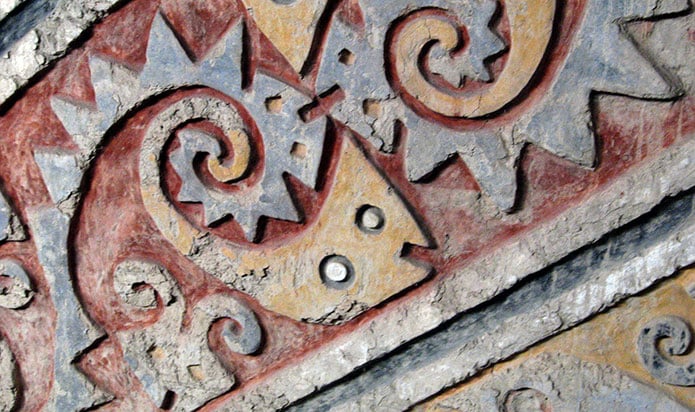
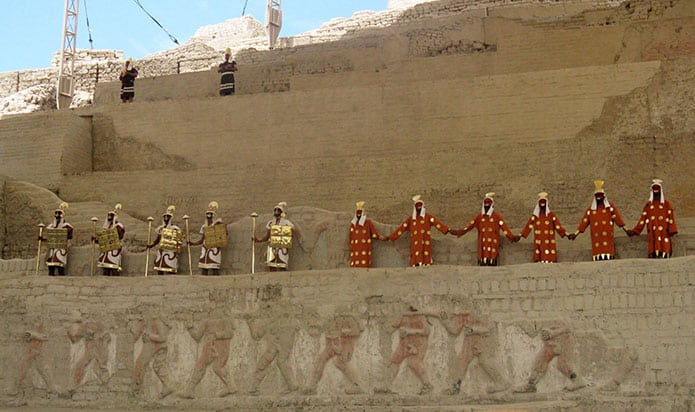
During its last phase, the temple was 30 meters high, with a base of about 120 meters on each side. In front of the temple is a large plaza, 140 meters long and 75 meters wide, facing north. From here you can see the stepped façade where the first polychrome reliefs were found. The designs show naked prisoners with ropes around their necks, dancers holding hands and the Decapitator carrying a prisoner’s head.
Excavations continue inside the temple and have uncovered ceremonial courtyards whose colors are exceptionally well preserved. As at the Huaca de la Luna, priests were buried inside each building.
ARCHAEOLOGICAL DISCOVERIES
Archaeologists found the tomb of a figure similar to the Lord of Sipán, accompanied by 15 individuals, 11 of them women. Unfortunately, the tomb had been looted, so neither the body nor the main offerings were found.
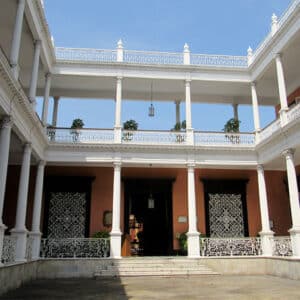
After the Moche left, the temple kept its ceremonial role. The Lambayeque people used the main plaza as a cemetery, and many mummies buried in a fetal position have been found from this period. When the Spanish arrived there was a large population here, so the Dominican friars built a Christian church on the old plaza, whose remains have survived to this day.
One of the most important discoveries in Peruvian archaeology is the tomb of the Lady of Cao, a Moche woman ruler who, like the Lord of Sipán, played a leading role in her society. What made the discovery extraordinary was that her body was found intact, skin included, with her arms tattooed with designs of serpents and spiders.
El Brujo and the Lady of Cao are waiting for you. See the details and prices of our tour by clicking here.
HUACA PARTIDA OR CORTADA
It stands opposite Huaca Cao. It is a much smaller building that has not yet been excavated. It may have been an administrative site of the Moche, and its location facing the sea has caused greater deterioration. A few years ago some fish designs could still be seen, but they are now covered.
HUACA PRIETA
It was studied by Junius Bird in 1946, who found here the first scientific evidence in Peru of people whose culture predated Chavín, then considered Peru’s “mother culture”. The site dates back to 2500 BC and belongs to the Preceramic period.
Advertisement