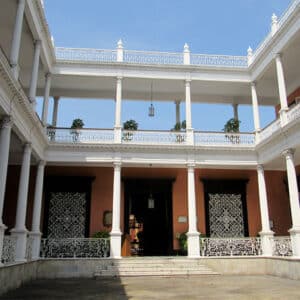
CASA CALONGE OR URQUIAGA
Jr. Pizarro 446. It is the headquarters of the Central Reserve Bank of Peru, which bought it from the Urquiaga family in 1972. It is Neoclassical in style. Inside, it preserves Simón Bolívar’s desk, a collection of ceramics and fine tableware given by the Liberator to Juan Antonio Ochaita y Urquiaga.
In 1604, the town council of Trujillo chose it as one of the two most beautiful and best-located houses in the city to host the new viceroy of Peru, Gaspar de Zúñiga y Acevedo, Count of Monterrey.
The earthquake of February 14, 1619, which left the city in ruins, completely destroyed the house. The property passed to the nuns of the Monastery of Santa María de Gracia de Santa Clara la Real in payment of debts that Juan de Solís y San Martín owed the monastery.
In March 1824, the Liberator Simón Bolívar arrived in Trujillo and became friends with Juan Antonio Ochaita y Urquiaga, the owner of the house. Bolívar stayed here, and from this house he organized much of his independence campaign and issued decrees declaring Trujillo the Capital of the Republic of Peru and creating the Superior Court of Justice.
CASA ORBEGOSO
Jr. Orbegoso 503. It has belonged to Interbank since 1987. This mansion has kept its typical colonial layout and much of its furniture and carpets from that period. It belonged to Marshal José Luis de Orbegoso y Moncada, the only person from La Libertad to have become President of Peru (1833-1835). The marshal inherited the house in 1815 from his father, Justo de Orbegoso, who was married to Francisca de Moncada, Countess of Olmos, and from 1825 he carried out major works on the property, such as removing a long corner gallery and replacing it with an enclosed balcony and large barred windows on the façades.
A new remodeling of the house, and especially of its façade, giving it the appearance it has today, including a new corner balcony, was carried out by Eduardo González de Orbegoso.
Its layout preserves the features of the city’s old houses, with wide corridors on a raised platform and broad steps from the courtyard. The plan is L-shaped.
The entrance hall preserves an 18th-century coffered ceiling, two green 19th-century benches, a wooden bracket with a lantern and layers of mural painting from the different remodelings of the house, in Mudéjar, Baroque, Mestizo Baroque, Rococo and Neoclassical styles.
CASA GANOZA CHOPITEA
Jr. Independencia 628. Its owners were the Ramírez y Laredo family, owners of the San Nicolás del Paso estate, now called Laredo.
This house has one of the most beautiful painted façades in the city. Its pediment is Baroque, flanked by two Rococo lions. The window is Empire style and the small balcony shows Mudéjar features. The entrance hall has murals in different styles: female figures in the Mannerist style (mid-17th century) on the arch, and on the side walls a motif repeated in the main courtyard, based on rectangles formed by thick Indian-red lines, in a Baroque style dating from the late 17th century. Above the shell that decorates the main door is a Rococo frieze.
CASA DEL MAYORAZGO DE FACALÁ
Pizarro 314, home to Banco Wiese (today Scotiabank) since 1991. The house was built in 1709 by Bartolomé Tinoco Cavero, holder of the Mayorazgo (entailed estate) of Facalá in the Chicama Valley.
In 1950 it was bought by Jaime de Orbegoso, who changed the façade, giving it a grand Neo-Colonial crown, and added a new corner balcony similar to the original. In the courtyard stands a statue of Christopher Columbus in Carrara marble, identical to the one in the courtyard of the Archive of the Indies in Seville; until 1943 it stood at the Santa Clara mill in the Barrios Altos of Lima. The fig tree was brought from the Government Palace in 1966, sent by Fernando Belaúnde.
Here Micaela Muñoz Cañete, wife of José Clemente Tinoco y Merino, embroidered the first flag of Peru, which was raised on December 29, 1820.
PALACIO ITURREGUI
Jr. Pizarro 688. This house is considered one of the most beautiful in South America. It was built in 1842 in the Neoclassical style, as a replica of a Renaissance Florentine palace. It is one of the few two-story houses in the city, although the upper floor was left out facing the courtyard, which has only colonnades, for better ventilation. The floors are of Spanish flagstone and Italian marble. The outer windows have the only wrought-iron, comb-shaped crowns in Trujillo, like those of Lambayeque.
Its owner, Juan Manuel Iturregui (1795-1871), was a hero of Independence, which he supported financially. He was a friend of General San Martín and a witness at his daughter’s wedding.
CASA DE LA EMANCIPACIÓN
Pizarro 610, owned by Banco Continental (today BBVA). In this house the Marquis of Torre Tagle conceived and planned the Independence of Trujillo. It was the seat of the Intendancy, of the First Constituent Congress and the Government House under Riva Agüero. Inside, there is a scale model of the historic center of Trujillo in colonial times. Its halls are always open for art exhibitions and cultural talks.
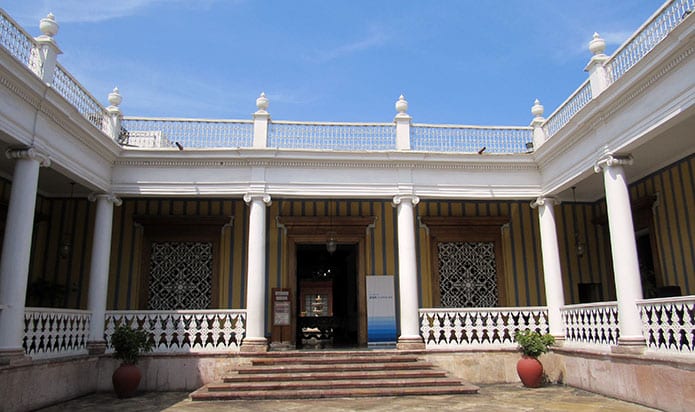
From 1789 the house was officially owned by Tiburcio de Urquiaga y Aguirre, a nobleman from Biscay married to Petronila de Anachuri. In 1820 Tiburcio gave part of the house to the Marquis of Torre Tagle to set up the Intendancy of Trujillo.
The Marquis called several meetings, until finally, on December 24, 1820, it was agreed to declare the independence of Trujillo that day and to proclaim it on the 29th, inviting the main towns of the Intendancy of Trujillo. So, on December 29, Intendant Torre Tagle left this house with a group of distinguished residents for the town hall, where Mayor Manuel Cavero y Muñoz, together with Tiburcio de Urquiaga, received them. At two in the afternoon, the Intendant proclaimed the Emancipation of Trujillo, and the act was signed by those present.
Advertisement