The site is located 8 km south of the city of Trujillo, in the countryside of Moche. This archaeological complex was the capital of the Moche culture between AD 400 and 600. It currently covers 120 hectares and is made up of the Huaca del Sol (Temple of the Sun), the Huaca de la Luna (Temple of the Moon) and the urban area between them.
The first Spanish conquistadors named them Sun and Moon, believing that the temples had been built by the Incas in honor of their two main gods: the largest for the Sun and the smaller one for the Moon.
HUACA DE LA LUNA
It stands opposite the Huaca del Sol, at the foot of Cerro Blanco. This hill was considered sacred because of its pyramid shape and light color.
The Huaca de la Luna is made up of three platforms and four ceremonial plazas, covering 290 by 210 meters. Excavations have focused on the main platform, which measures 90 meters on each side and is 20 meters high. Six superimposed buildings have been discovered, built over some 600 years. Each building was used for an average of 100 years; at the end of that period it was filled in with adobe blocks so a new one could be built on top, possibly following a ceremonial calendar. Burial chambers for priests were built inside the old buildings.
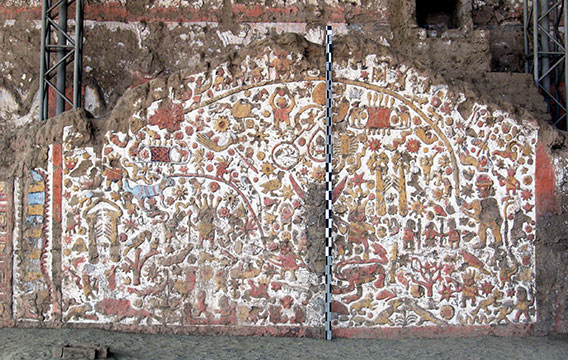
The original entrance faces north, where the great ceremonial plaza lies, 180 meters long and 90 meters wide. The plaza is still being excavated. From here you can see the stepped façade, once beautifully decorated with polychrome reliefs painted with ochre mixed with cactus sap.
The first step shows warriors carrying their weapons and leading naked prisoners on ropes. The other steps show dancers or officiants holding hands and wearing red tunics; giant spiders carrying the tumi, or ceremonial knife; warriors holding fish; felines with reptile bodies holding a human head in their claws; and finally a long serpent. An older façade depicts the god Ai Apaec, or the Decapitator, holding a knife in his left hand and a sacrificed head in his right, and wearing a belt of serpents ending in condor heads.
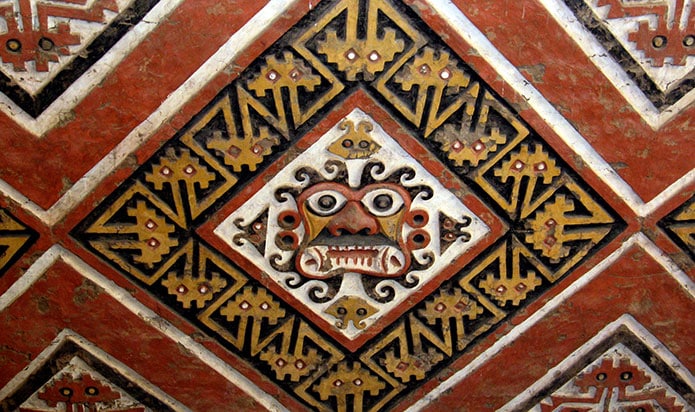
Inside the temple there were ceremonial courtyards. In one of them was the room of the high priest, with a good view of the main plaza. Another, larger courtyard, measuring 60 by 40 meters, shows the face of the god Ai Apaec inside a black diamond with 16 stylized serpent heads.
Numerous skeletons of sacrificed warriors have also been found around a rock outcrop. Curiously, all the remains are of men and show cut marks on different parts of the body.
HUACA DEL SOL
It stands very close to the Moche River, which is why some researchers have suggested it had an administrative function linked to control of the valley. It is also known as Capuxaida or Pachacamac.
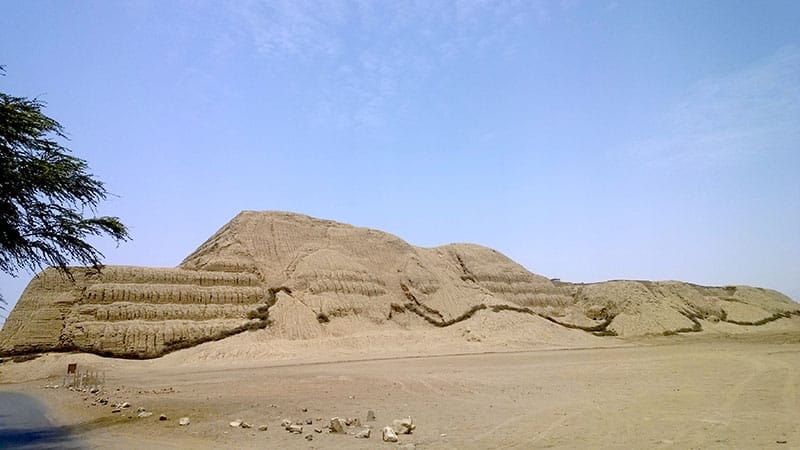
It is estimated that 140 million adobe bricks were needed to build it. Today it is on average 40 meters high, with a base of 340 by 160 meters.
In 1604, a group of treasure hunters diverted the river to open up the temple and find its hidden treasures. As a result, two-thirds of its original structure was lost.
Advertisement