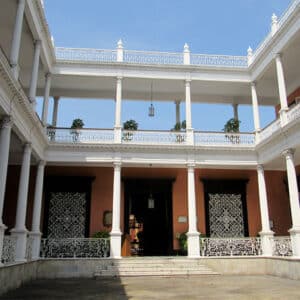

The oldest evidence of human presence on this part of the north coast dates back to 10,000 BC, when semi-nomadic people used stone tools for hunting, fishing and gathering fruit. This is why the period is called the LITHIC.
It coincides with the end of the Pleistocene (the Ice Age) and the beginning of the Holocene (when the glaciers retreated). The climate was probably humid, with abundant vegetation thanks to heavy rains.
No evidence older than 12,000 years has been found on the coast. Scholars explain that 13,000 years ago the sea level was 50 meters lower than today and only stabilized 7,000 or 6,000 years ago. This means the coast was wider, and if earlier human groups lived there, their remains would now be under the sea.
The Paiján tradition is the most important of the Lithic period on the coast, covering the area between Piura and Ica. These people were hunters and gatherers who used triangular stemmed points with straight or slightly concave edges. The stems at the base allowed them to be tied to a shaft and used as harpoons.
The most representative sites are La Cumbre and Quirihuac in the Moche Valley, Pampa de los Fósiles (Paiján) and Cuculicote (Ascope). Groups numbered no more than 50 people per band. Their diet was varied: at Pampa de los Fósiles there is evidence of large fish, and at Cuculicote, César Gálvez found remains of land snails, river crabs, viscachas, iguanas, birds and, to a lesser extent, fish.
ARCHAIC PERIOD (6000-1800 BC)
This period is linked to the emergence of the tribe, a group of bands united by kinship and living in a shared territory. It covers the long process through which animals and plants were domesticated.
Agriculture led to a settled way of life and the appearance of permanent settlements. However, none of the cultivated plants is native to the coast, since there are no wild ancestors here; they arrived already domesticated from the highlands or the jungle.
Textiles and the first religious expressions appeared. The most important sites were Huaca Prieta (Chicama Valley), Alto Salaverry (Moche Valley) and Cerro Negro or Prieto (Virú Valley).
EARLY HORIZON (1700-100 BC)
This is the period of the cultures that knew pottery. The oldest pottery on the coast (1700 BC) was discovered at Guañape, in the Virú Valley. In 1967, Lanning noticed that the human faces on the pyro-engraved gourds of Huaca Prieta resembled the pottery of Valdivia in Ecuador, dated to 2300 BC. He believed this was no coincidence and that the craftsman who decorated the gourds had seen the Valdivia designs.
In this period religion organized society, and the building of temples following a similar pattern marked territorial control. The most important cultures of the north coast were:
THE CUPISNIQUE CULTURE (1500-500 BC)
It covered the area between Santa and Lambayeque. Its pottery is black, dark brown or red, because it was fired in closed kilns, and is decorated with incisions or reliefs.
Its main site in the Moche Valley was the Caballo Muerto complex, in the district of Laredo. It has eight buildings, seven of them U-shaped. The most notable is Huaca de los Reyes, studied by Luis Watanabe (1972-1979), which measures 270 by 230 meters and is 18 meters high. Its walls have friezes with stylized human heads and standing figures, and its main feature is the presence of feline traits.
THE SALINAR CULTURE (500 BC-AD 100)
It was identified in 1941 by Rafael Larco Hoyle at Pampas de Jagüey, in the Chicama Valley. Its pottery has the natural reddish color of fired clay. Its main site in the Moche Valley is Cerro Arena, covering 2 km².
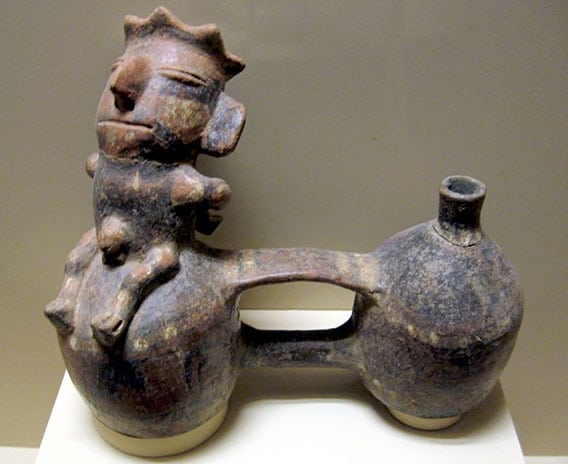
THE VIRÚ OR GALLINAZO CULTURE (200 BC-AD 200)
It spread between the La Leche and Santa valleys. Its main center was the Virú Valley, with sites such as the Castillo de Tomaval, San Juan and Huancaco. Its pottery is red, decorated with incisions and white paint. A typical feature is the negative technique, which consisted of applying a black organic pigment.
EARLY INTERMEDIATE PERIOD (100 BC-AD 750)
During this period agriculture became the backbone of society. For the first time, complex burials appear for high-ranking individuals, who were buried with many offerings in specially prepared places, as in the case of the Lord of Sipán. The state and the city emerged, as shown by the building of palaces and private residences, the imposition of tribute and the establishment of regional capitals.
War became the way to consolidate power and expand territory, and to capture prisoners and use their labor; in other cases, prisoners were sacrificed to the gods of the victors. The most representative culture of this period is the Moche, or Mochica.
THE MOCHE OR MOCHICA CULTURE
The Moche culture flourished between the 1st and 8th centuries AD. Its territory stretched for some seven hundred kilometers, from Piura in the north to Huarmey in the south.
For a long time the Moche Valley was considered the main center of this culture. However, archaeologists such as Luis Jaime Castillo believe the Moche had no single capital, but built a regional center or capital in each valley: Loma Negra in Piura; Sipán and Pampa Grande in Lambayeque; Dos Cabezas and San José de Moro in Jequetepeque; Huaca Cao and Huaca Partida in Chicama; the Huacas del Sol y de la Luna in Moche; and Pañamarca in Nepeña.
Towards the end of the 6th century, after a severe El Niño event, Moche society declined. In the Moche Valley the capital moved to Galindo, and in Lambayeque the population settled at Pampa Grande.
Their economy was based on agriculture, for which they built many irrigation canals. Other economic activities appear on their ceramics, such as deer hunting and fishing from “caballitos de totora”, reed boats.
In the temples, the main god depicted is AI APAEC, characterized by feline features. On ceramics, this god has the body of animals such as a crab, a spider or an eagle, and is also shown on an ear of corn or on a mountain. He is also known as the Decapitator, because he is shown holding a tumi, or knife, in one hand and a human head in the other. The sea, the moon and the rainbow were other important deities.
Their metalwork surpassed that of the Chimú. They worked gold, silver and copper, and knew the technique of “tumbaga”, an alloy of copper and gold. The objects found in the tomb of the Lord of Sipán are the finest example of Moche goldsmithing.
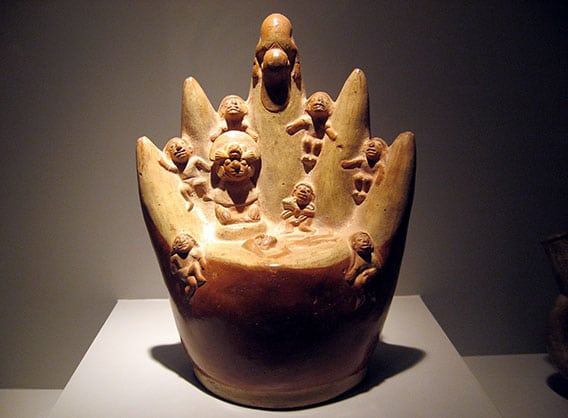
Of all the Peruvian cultures, Moche pottery is the most realistic and expressive. Its classic colors were red and cream. The activities depicted are ceremonial, and the pieces were used as offerings in temples and burial platforms. Rafael Larco Hoyle (1948) classified Moche pottery into five stylistic phases.
LATE INTERMEDIATE PERIOD (AD 750-1470)
THE CHIMÚ CULTURE
As with the Incas, the origin of the Chimú is told in a legend recorded in an Anonymous Chronicle (1604-1610), according to which their founder was a mythical figure called Taycanamo, who arrived by sea on a raft.
This culture, which later became a powerful state, began around AD 850 and lasted until 1470, when the Incas conquered it and annexed it to the Tahuantinsuyo.
For nearly 600 years, the Chimú expanded their territory with a well-organized army. Around 1370 they conquered the Lambayeque or Sicán culture, which greatly boosted the development of goldsmithing in Chan Chan.
Minchancaman was the great conqueror: during his reign the Chimú controlled the entire north coast of Peru, from Tumbes to Lima (the Chillón River), more than 1,000 km. Yet Minchancaman was fated to witness the fall of his vast kingdom. An army of more than 30,000 soldiers led by Túpac Inca Yupanqui, son of Pachacutec, forced his surrender. According to historical evidence it was a peaceful conquest, so Chan Chan was not looted. The ruler was taken to Cusco along with hundreds of craftsmen: potters, goldsmiths and weavers.
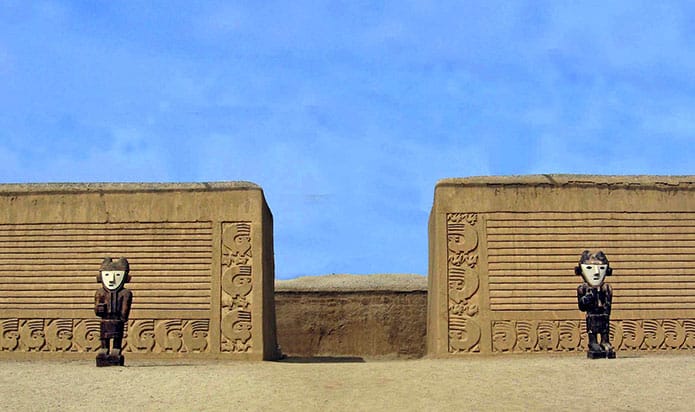
In Chan Chan, Minchancaman’s son and heir, Chumuncaur, took the throne, but under Inca rule. The Inca representatives set up their headquarters at Chiquitoy Viejo, in the Chicama Valley, which led to the decline and abandonment of Chan Chan.
Finally, during the rule of Caja Cimcim, the Spanish conquistadors arrived in the Moche Valley, and the looting and destruction of temples and palaces began.
ECONOMY:
Agriculture was the basis of the Chimú economy. They built irrigation canals and made use of water seeping from the subsoil. They grew lima beans, corn, beans, gourds, squash, sweet potatoes, cassava, chili peppers, caigua and peanuts; fruits such as ciruela, lucuma, soursop, pacay, avocado and cherimoya; and building plants such as totora reed, cane and cattail. Cotton was the most important non-food crop. Guano from the islands was used as fertilizer.
Fishing, hunting and herding were other important activities. They did not use money; trade was based on bartering goods.
Crafts were very important. Chan Chan had workshops producing textiles not only for local use but also for trade.
They were expert metalworkers, mainly in gold, silver, copper and bronze.
LANGUAGE:
According to the Spanish chroniclers, the Chimú did not have a single language, but several regional ones:
– Sec language, also known as Tallán, spoken in Tumbes and Piura.
– Muchic or Yunga language, spoken from Motupe to Chicama. In the 17th century, Father Fernando de la Carrera recorded its use in 26 towns of the northern coast and highlands, and estimated the number of its speakers at 40,000.
– Olmos language, associated with the Olmos area.
– Quingnam language, in the Moche, Virú and Chao valleys.
– Pescadora language, in Pacasmayo and Guadalupe.
RELIGION:
The Chimú state and the city of Chan Chan relied on religion as the foundation of their power, and monumental buildings almost always had a ceremonial function. The main cult was dedicated to the Moon, called Si. It was considered more powerful than the Sun because it could be seen both by day and by night. When the Moon did not appear, it was because it was in the other world punishing thieves.
They celebrated solar eclipses as proof that the Moon had defeated the Sun, while lunar eclipses caused sadness. The Moon was also seen as the protector of fishing. Sian, “House of the Moon” in the Yunga language, was the temple where ceremonies were held.
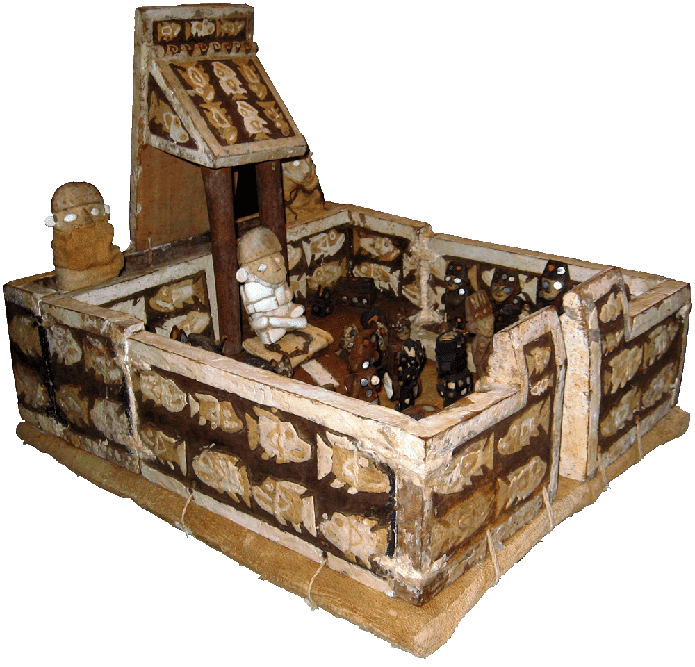
The stars were also worshipped. According to the chroniclers (Calancha, 1638), the ancient inhabitants believed that their ancestors were four stars, those that form the constellations of Canis Major and Piscis Austrinus. The largest and brightest stars gave rise to the nobles and leaders, while the smallest and palest gave rise to the humble and the commoners. Other stars, called Pata (the Orion constellation), symbolized three beings: the central star was a thief and the other two were his captors, sent by the Moon to catch the thief and hand him over to the vultures.
Other gods were Ni, the sea, and stone gods called Alaec pong. They also had a special cult of the mummies of their main ancestors.
Advertisement