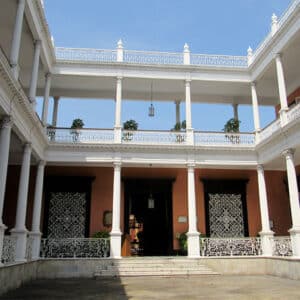
Otuzco is known as the “Capital of Faith” because of its deep devotion to the Virgen de la Puerta, “Our Lady of the Gate”. The town lies at 2,635 m (8,645 ft) above sea level, just 73 km from Trujillo. The road is fully paved, so the trip takes about an hour and a half.
Otuzco was founded by Augustinian friars in 1560 under the name “Pueblo de la Inmaculada Concepción de Nuestra Señora de Copacabana de Otusco”. During the colonial period it was a resting place for travelers on the road from Trujillo to Huamachuco.
The province of Otuzco was created on April 23, 1861, under the government of Ramón Castilla. Originally the main religious festival was dedicated to the Virgin of the Immaculate Conception, whose feast day is December 8. Later a new image was brought from Venezuela, known as the “INTER” because it was the secondary image that replaced the Immaculate Conception in some minor religious celebrations. Over time, however, the “INTER” became more and more important.
In 1664 the bishop of Trujillo, Juan de la Calle y Heredia, authorized the patronal festival of the Virgen de la Puerta.
On October 27, 1943, during the Third National Eucharistic Congress in Trujillo, the Virgen de la Puerta of Otuzco was crowned by Monsignor Fernando Cento, representative of Pope Pius XII, as “Patron Saint of Northern Peru and Queen of Universal Peace”. The main church was built between 1950 and 1986, but the Virgin was moved there on October 27, 1983.
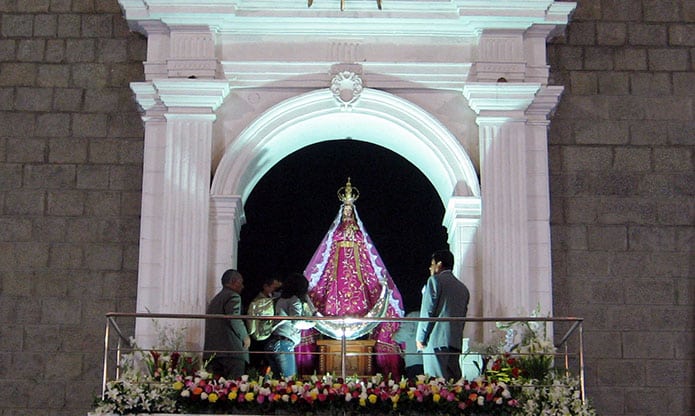
The church has three naves and is built entirely of stone. The Virgin’s throne is located on the façade, facing the Plaza de Armas.
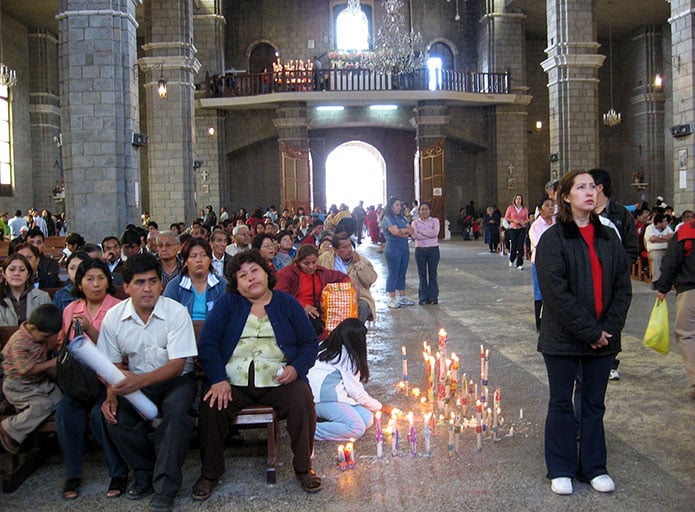
The patronal festival takes place from December 13 to 15. The Virgin is lowered from her throne on the morning of December 14 using a special system of pulleys. The image is placed on the main altar of the church, where thousands of pilgrims wait in long lines for the act of “adoration”, which consists of praying before the Virgin. Some touch her mantle, others kneel to ask for healing; all have faith that the “mamita” will help them reach their goals. They will then return the following year as a sign of gratitude.
The main day is December 15, when the procession goes through the main streets of the town, packed with pilgrims from all over Peru and abroad. Some sleep in the Plaza de Armas, others in the church atrium or wherever they can find space. If it rains that day, it is a sign of a good year for farming.
Advertisement