
PLAZA DE ARMAS
It was from the Plaza Mayor (main square) that Francisco Pizarro began laying out the city with his sword.
Around the square stand the Government Palace, the Municipal Palace, the Cathedral and the Archbishop’s Palace. In the center is a beautiful bronze fountain, installed in 1651 under Viceroy García Sarmiento de Sotomayor, Count of Salvatierra.
It was designed by Pedro de Noguera and cast by Antonio de Rivas. The basin is shaped like an eight-petaled rose, and at the joints between the petals are eight lions attacking winged serpents. The central body is about 10 meters high and is crowned by a statue of the Angel of Fame blowing a trumpet and holding the coat of arms of Spain in her left hand.
General José de San Martín proclaimed the independence of Peru from a platform in the Plaza Mayor on July 28, 1821.
GOVERNMENT PALACE
It is the seat of the executive branch and stands on the same site where Francisco Pizarro established the seat of his governorship.
The first building was begun by Pizarro and completed under Viceroy Andrés Hurtado de Mendoza, Marquis of Cañete (1556-1561). The present building dates from 1926-1938: it was begun under President Leguía and completed in 1938 under President Óscar R. Benavides, to a design by the Polish architect Ricardo de Jaxa Malachowski.
MUNICIPAL PALACE
At first the town council had no building of its own, until in 1556 it opened its headquarters on a lot bought from Hernando Pizarro. This first building was used until 1923, when a fire destroyed it completely.
The present building was inaugurated on July 2, 1944. It was designed by the architects José Álvarez Calderón and Emilio Harth-Terré, and the interior decoration was directed by Ricardo Malachowski, who also designed the Government Palace and the Archbishop’s Palace. Its façade is Neo-Colonial.
THE CATHEDRAL
The first church was begun by Francisco Pizarro. It was raised to the rank of cathedral by Pope Paul III on September 17, 1543, and placed under the protection of Saint John the Evangelist.
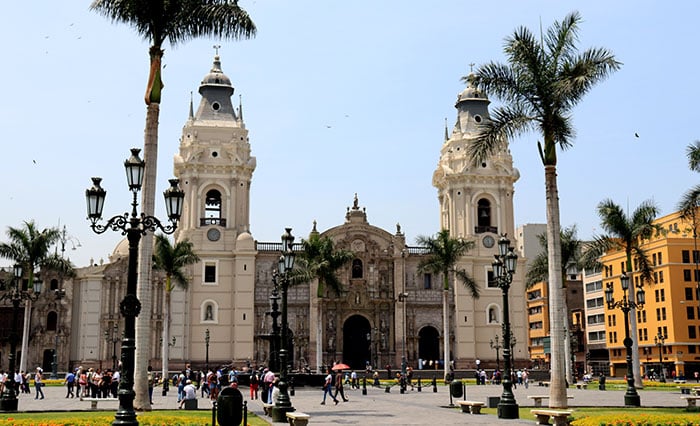
The present building was designed by Francisco Becerra. Work began in 1596 and was completed in 1622, but the building was destroyed by the earthquake of 1746. Viceroy José Antonio Manso de Velasco then ordered the construction of a new cathedral, which only began in 1755.
The façade, portal and towers were completed under Viceroy Manuel Amat in 1778. The façade, by Martínez de Arrona and Pedro de Noguera, is like a wooden altarpiece but carved in stone imported from Panama.
After the earthquake of 1940, the cathedral was restored under the direction of Emilio Harth-Terré.
Inside, the highlights are the main altar and the altarpieces of Saint Toribio de Mogrovejo, Saint John the Baptist and the Virgin of Candelaria. The chapel near the entrance holds the tomb of Francisco Pizarro, whose skull is kept in a lead box. You can also visit the crypts.
ARCHBISHOP’S PALACE
The present building is Neo-Colonial, the work of the architect Ricardo Malachowski, inspired by the Torre Tagle Palace. It was inaugurated on December 8, 1924, and its façade is known for its beautiful wooden balconies.
CHURCH OF SANTO DOMINGO
It is considered the most characteristic Gothic church in Peru, with Mudéjar touches. The most remarkable part is the Baroque main cloister, decorated with thirty thousand glazed tiles, the work of Hernando de Valladares.
CHURCH AND CONVENT OF SAN FRANCISCO
The old church and convent were destroyed by the earthquake of November 13, 1655.
The present church was designed by the Portuguese architect Constantino de Vasconcelos and the Lima master builder Manuel de Escobar, and was inaugurated on October 3, 1672.
Most of the altars were destroyed in the earthquake of 1746. The restoration was directed by the priest Matías Maestro, who also made the Neoclassical main altarpiece.
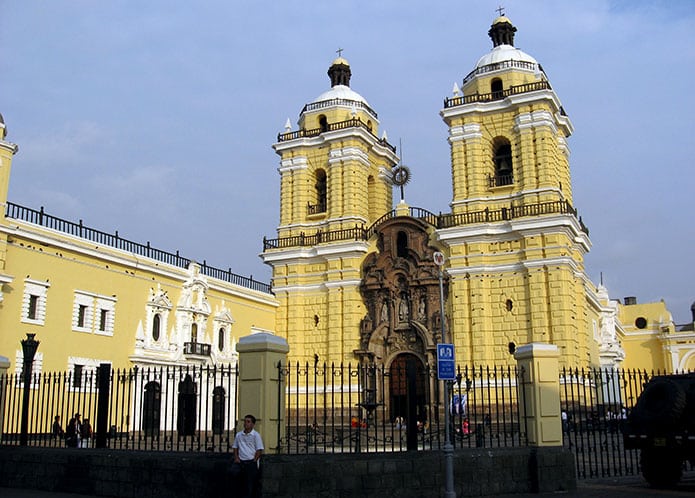
Among its highlights are the glazed tiles brought from Seville, donated by various people, including Catalina Huanca, a goddaughter of Francisco Pizarro who, according to tradition, came from Huancayo with fifty mules loaded with gold and silver. Beneath the church are the catacombs, where it is estimated that some twenty-five thousand people were buried. After being cleaned, they were opened to the public in 1950.
CHURCH OF LA MERCED
The present church was rebuilt after the earthquake of 1687 by Diego Maroto, Manuel de Escobar and Pedro de Asensio.
Its Baroque altarpiece-façade dates from 1697-1704 and is carved in soft Panamanian stone. The main altar was rebuilt after the earthquake of 1746 by the priest Matías Maestro, and gilded in 1810 by the painter Félix Batlle.
The church holds the remains of Pedro Urraca, to whom various miracles are attributed.
CHURCH OF SAN PEDRO
It was originally called San Pablo, but after the expulsion of the Jesuits in 1767 it was renamed San Pedro.
It was built between 1624 and 1638 in the Renaissance style, modeled on the plans of the Gesù church in Rome.
Together with the Cathedral, it is one of only two churches with three entrances. According to tradition, the Jesuits built it in defiance of a church rule that only a cathedral could have that many doors, so it was forbidden to open all three at the same time.
The church preserves one of the oldest series of angel paintings in the Americas, by Bartolomé Román, as well as paintings by the famous Jesuit painter Bernardo Bitti.
CASA ALIAGA
It stands next to the Government Palace. It is the only house whose owners descend from the first owner, Captain Jerónimo de Aliaga y Ramírez, who was with Pizarro on the Isla del Gallo.
It is considered the oldest house in the Americas still owned by the same family, as construction began in 1535. It was built on top of an indigenous temple of the chief Taulichusco. Its main rooms include the Tile Room, the Golden Room, the Chapel and a bedroom with a colonial bed.
TORRE TAGLE PALACE
The house was built between 1733 and 1740 by José Bernardo de Tagle y Bracho, who in 1730 was granted the title of first Marquis of Torre Tagle by King Philip V.
It was the residence of José Bernardo de Torre Tagle y Portocarrero, who was President of Peru and Intendant of Trujillo. It is known for its Mudéjar-style wooden balconies. Since 1918 it has been the headquarters of the Ministry of Foreign Affairs.
CASA RIVA-AGÜERO
It was built around 1760, and its style recalls both the colonial period and the early Republic. The historian José de la Riva-Agüero y Osma inherited it in the early 20th century. When he died in 1944, the house and all his property passed, according to his will, to the Pontifical Catholic University of Peru.
PLAZA SAN MARTÍN
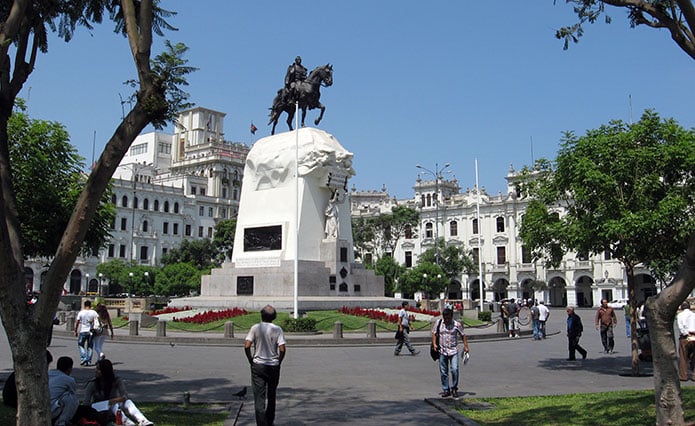
It is dedicated to the liberator José de San Martín and was inaugurated on July 27, 1921, for the centenary of Peru’s independence. The square was designed by the Spanish architect and sculptor Manuel Piqueras Cotolí, and the statue of San Martín is by the Spanish sculptor Mariano Benlliure.
PLAZA BOLÍVAR
This square was remodeled around 1853. The monument to Bolívar is by the Italian sculptor Adamo Tadolini and was inaugurated on December 9, 1859, on the anniversary of the Battle of Ayacucho.
CONVENT OF LOS DESCALZOS
The convent has a museum with more than five hundred paintings of the Lima, Quito and Cusco schools.
PASEO DE AGUAS
It was built under Viceroy Amat y Junyent, the work of the Spaniard Juan Gutiérrez.
According to Lima tradition, the Paseo de Aguas was a gift from Viceroy Amat to the actress Micaela Villegas, “La Perricholi”, with whom he fell madly in love.
RAFAEL LARCO HERRERA ARCHAEOLOGICAL MUSEUM
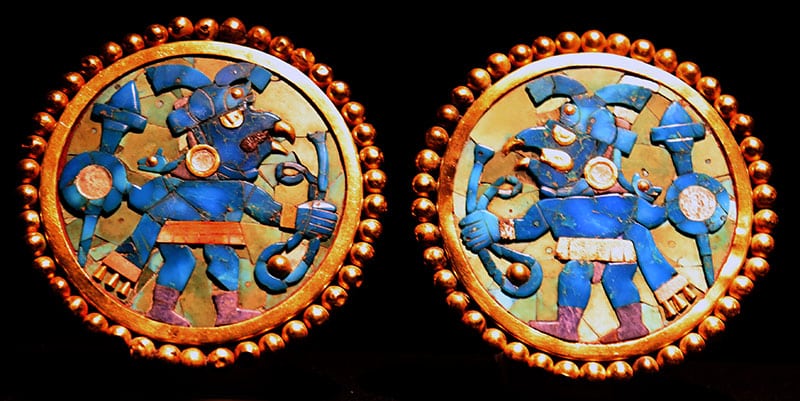
It is the most complete museum devoted to the cultures of northern Peru. It was founded in 1926 by Rafael Larco Hoyle at the Chiclín estate in the Chicama Valley and later moved to Lima. It is named after his father.
NATIONAL MUSEUM OF ARCHAEOLOGY, ANTHROPOLOGY AND HISTORY
This museum offers detailed information on the history of Peru. The first part is devoted to the pre-Hispanic cultures, from the earliest period to the Incas.
The exhibition shows the art of the most important cultures, including ceramics, textiles, goldwork and sculpture from the Chavín, Nasca, Paracas, Wari, Moche, Lambayeque and Chimú cultures.
HUACA PUCLLANA
Also called Huaca Juliana, it is located in the district of Miraflores and was one of the most important centers of the Lima culture. Its name comes from the Quechua “pukllay”, “to play”, meaning “place of games”, in reference to the ceremonial games held at the temple.
The huaca has two areas: a large pyramid 22 meters high, and a lower area of plazas with benches that probably had everyday functions. Huaca Pucllana lost its importance under Wari rule.
SAN ISIDRO
It is one of Lima’s most exclusive districts, a modern area with large houses, shopping centers and luxury stores.
It was once a hacienda, but from the 1920s it was planned as a residential area, designed by Manuel Piqueras Cotolí.
MIRAFLORES
Miraflores was a seaside resort on land that had belonged to the Mercedarian friars. In the early 18th century the land passed to Manuel Fernández Dávila, who extended the farmland to the cliffs.
During the 19th century the indigenous farmers gradually sold their plots, and from the 1970s Miraflores became the center of Lima’s tourism.
Miraflores has the most modern hotels and some of Lima’s best-known restaurants. Facing its main park are the church of the Virgen Milagrosa, built in 1939, and the Municipal Palace of 1941, both Neo-Colonial.
BARRANCO
It is an emblematic district associated with Lima’s high society and, today, with artists and bohemian life. Its most popular spot is the Bridge of Sighs (Puente de los Suspiros), a wooden bridge built in 1876 to span a ravine and connect Ayacucho and La Ermita streets.
Another highlight is the church of La Ermita, which began as a small chapel used by fishermen. After the earthquake of 1940 destroyed it, a new church was built facing the Municipal Square. Its design is Neo-Colonial, and it was consecrated by the Archbishop of Lima, Juan Landázuri, in 1963.
Advertisement


