The village name Cocachimba comes from Quechua: Coca (kuka) and Chimba (chimpa), “the other bank”. A chimbador is a man whose job is to guide people across a river, and chimbar (chimbay) means to cross a river, by swimming or by boat, in the Andes and the jungle.
When it was announced to the world in 2006, Gocta was presented as the third-highest waterfall in the world, after Angel Falls in Venezuela and Tugela in South Africa; later measurements and rankings place it lower, but it remains one of the highest and most impressive. Although local people always knew it, it became known internationally thanks to the German Stefan Ziemendorff, who first visited it in 2002.
To visit the waterfall from Chachapoyas, you take the road towards Pedro Ruiz as far as the Cocahuayco bridge, an hour away. From there a gravel road climbs to the village of Cocachimba in about 20 minutes. Along the way, orange trees drop their ripe fruit onto the road.
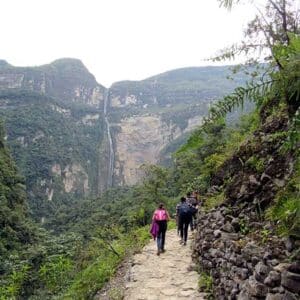
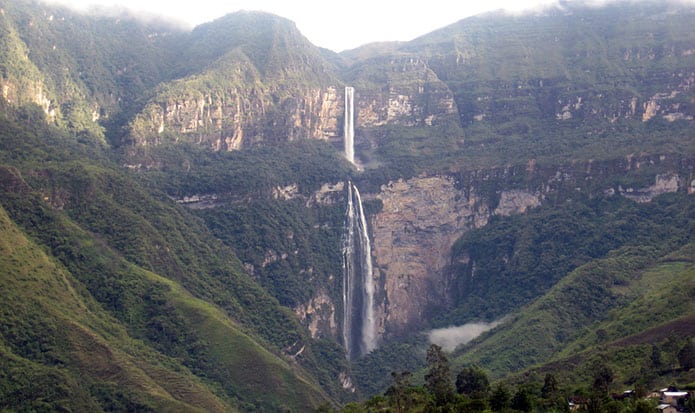
Halfway up, the landscape opens up to reveal a semicircle of waterfalls, up to 22 in the rainy season. The most imposing appears on the left: a waterfall in two drops, the first short and the second astonishing. Its name is Gocta, and it is 771 meters high.
In Cocachimba, a few families live in adobe houses. The village has a large football field and a community house where you buy entrance tickets to the waterfall. You must hire a local guide; the villagers have organized a rotation so that everyone has the chance to work. Before setting off, you can buy drinks at a small shop called “Gocta”, which also has public toilets and, if needed, a place to sleep.
The trail to Gocta is fairly new. The first stretch is hard and the climb leaves you breathless, so you will need to rest a couple of times before reaching the first flat section. The path is narrow but pleasant, and the shade of the trees helps against the sun. After an hour’s walk you descend a little to cross a wide ravine, then climb slowly again. To one side you can hear the Cocahuayco River, which is born from the waterfall. This is the hardest section: you walk through mud, and ropes tied to the trees are a great help for climbing; otherwise, hold on to roots to avoid falling.
The sugarcane presses along the way are good places to catch your breath. If you run out of water, there is a small shop where you can find beer, water, soft drinks and the typical drink, guarapo (sugarcane liquor). If you can go no further and have a tent and sleeping bag, this is the ideal place to spend the night. Only 60 minutes of walking remain.
The last stretch follows the river, and the roar of the waterfall grows close. The chatter of parrots welcomes you; you cannot see them, but they are clearly watching from the treetops. Knowing you are only steps away, you tackle the final part with enthusiasm. You are at 1,700 m (5,580 ft) above sea level and your breathing quickens. It is hard to take photos up close, as the strong wind creates a persistent drizzle of tiny drops. Many visitors bring swimsuits, but it is almost always cold, and only the bravest swim under the falls. It is best to bring a poncho and rubber boots, as it may rain heavily on the way back.
In the rainy season (December to March) the waterfall is majestic, and its roar can be heard from Cocachimba. In the dry months the flow is thinner, and some visitors who have seen falls such as Iguazú find it modest. For most people, however, visiting Gocta is an unforgettable experience.
Advertisement