
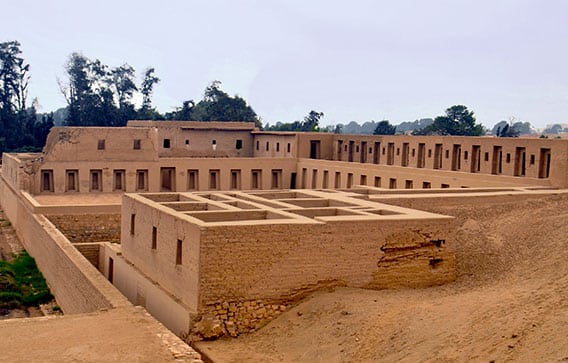
SANCTUARY OF PACHACAMAC
It was the most important religious sanctuary in this region. It stands on the right bank of the Lurín River and covers 200 hectares. According to the Inca Garcilaso de la Vega, the name Pachacamac comes from two Quechua words: Pacha, “world”, and Camac, “to animate”.
According to the chroniclers, its ancient name was Ychsma or Irma, from the Ichma culture, which was later conquered by the Incas. They continued to use the sanctuary and built a Temple of the Sun and another of the Moon. At the top of the temple stood the wooden idol of Pachacamac.
Pachacamac lies on flat land with three rocky outcrops, on which the most important buildings were raised:
– The Temple of the Sun:
It reaches 40 meters in height and is the tallest and best-preserved building in the sanctuary.
– The Old Temple:
It is built of small adobe bricks, which suggests it was one of the first structures on the site. Its façade still has five steps, and its base is of stone later plastered with mud.
Historical sources say that the façade facing the sea was the most richly decorated. Some of its trapezoidal openings show work from the Inca period.
– The Taurichumpi Complex:
It is named after the chief Taurichumpi, who lived here at the time of the Spanish invasion.
Other buildings are:
– The Temple of the Moon or Acllahuasi:
It was restored in the 1940s by the Peruvian archaeologist Julio C. Tello. This is thought to be where the acllas, the “chosen women”, lived, dedicated to the worship of the Sun or chosen as concubines for the Inca. It was also used for ceremonies to the Moon and the Earth, or Pachamama. It is a typical Inca building, as shown by its double-jambed trapezoidal niches and some stone walls.
– The Pilgrims’ Plaza:
It is thought to have been used by the pilgrims who came to the sanctuary.
– The Huacas or Palaces:
Also known as the “regional embassies”, because according to the chronicler Antonio de la Calancha (1639) they were the diplomatic and religious seats of the different peoples who worshipped the idol of Pachacamac. They were probably built before the Inca conquest.
– The Painted Temple of Pachacamac:
A pyramid-shaped structure with nine terraces, which were once painted.
CARAL
Caral is considered the oldest city in the Americas, some 5,000 years old. It covers 66 hectares. Its central area has 32 public buildings, several residential complexes and an outer zone.
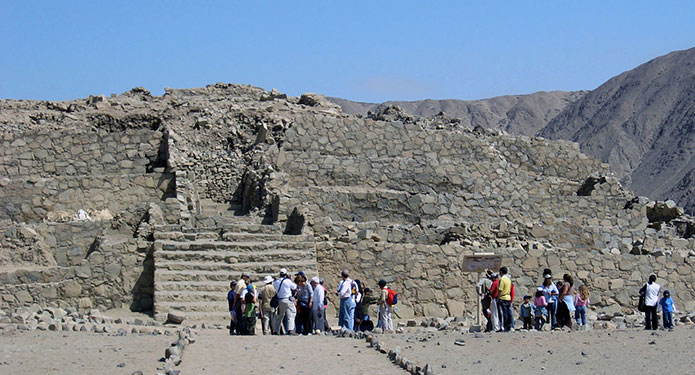
In the central area, the buildings were divided into two large halves: Upper Caral to the north and Lower Caral to the south.
In the Upper Half the highlights are the Central Pyramid, the Quarry Pyramid, the Great Pyramid, the Lesser Pyramid, the Gallery Pyramid and the Huanca Pyramid.
The Lower Half has smaller public buildings, as well as the homes of officials and a smaller residential complex. The main buildings are the Amphitheater Temple, the Bench Temple and the Temple of the Circular Altar.
PURUCHUCO
It is located at kilometer 11 of the Lima-Chosica road. It is thought to date from the Inca period because of its trapezoidal doorways and niches, typical of Inca architecture.
The site was restored by Arturo Jiménez Borja and Francisco Iriarte Brenner between 1952 and 1961.
Advertisement


