
Cerro Sechín lies about five kilometers from Casma, at the foot of Sechín hill, in the area where the Sechín and Casma rivers meet.
Julio C. Tello discovered this important site in 1937, while in the Casma Valley as part of the Archaeological Expedition to the Marañón. His first excavation lasted three months and uncovered the main façade. Many of the carved stones had been moved from their original places, and others were damaged. Tello found an adobe temple and a stone temple.
Further excavations were carried out in 1969 and between 1971 and 1974 under Arturo Jiménez Borja and Lorenzo Samaniego. The site is estimated to date from around 1800-1500 BC.
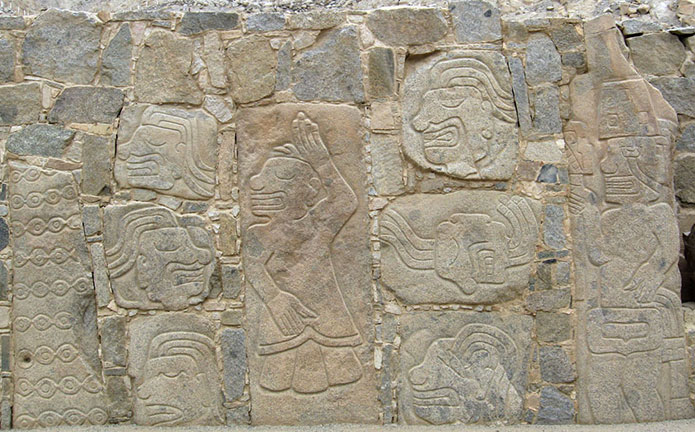
The earliest building was of adobe and had three phases; it was decorated with painted reliefs, including human figures and fish. The outer wall is lined with some 300 carved stone slabs of granodiorite. One side of each stone was smoothed, the design was drawn, and then it was incised with a harder, pointed stone.
The designs start from the center of the south wall, where the entrance is, and end at the north side, where there are two standards. They show a procession of warriors, with headdresses and face paint, alternating with images of defeated and dismembered enemies: severed heads, limbs and stacks of eyes.
THE FUNCTION OF SECHÍN
Sechín was probably a temple linked to ritual warfare and sacrifice, or a monument commemorating a great victory. Its style is older than Chavín de Huántar: the typical Chavín symbols, such as the serpent, the condor and the feline, do not appear at Sechín.
The Site Museum uses models and graphics to help visitors understand the monument and its purpose.
Advertisement