
Chavín de Huántar lies at 3,185 m (10,450 ft) above sea level and covers about 45,000 m². It owes its name to the fact that the village once belonged to the district of Huántar; the district of Chavín was created later.
The most important early descriptions were made by Charles Wiener (1880) and Ernst Middendorf (1893-95). Excavations began in 1919 with Julio C. Tello, but in 1945 a flood of mud covered the site, and cleaning work was carried out between 1955 and 1965 under Marino González.
Chavín stands at a “tinkuy”, the meeting point of the Mosna and Huachecsa rivers, a sacred place in Andean thought. It was abandoned before the Christian era and was later occupied by people of the Huaraz and Recuay cultures.
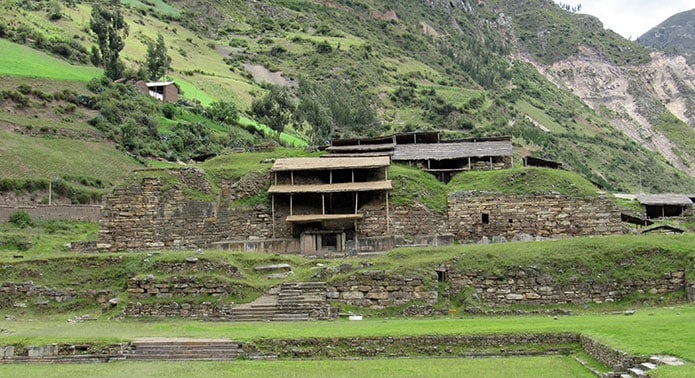
ARCHITECTURE
The temple is divided into several sectors:
The North Sector covers an area of 90 by 45 meters and consists of two superimposed platforms. A Christian chapel once stood on top, which Julio C. Tello turned into a museum; it was destroyed by the flood of 1945.
The Circular Plaza is 21 meters in diameter and sunken, with stone panels carved with jaguars and figures carrying the San Pedro cactus. There are channels in its floor.
The Square Plaza measures about 47 by 49 meters and is aligned almost perfectly with the portal of the Castillo.
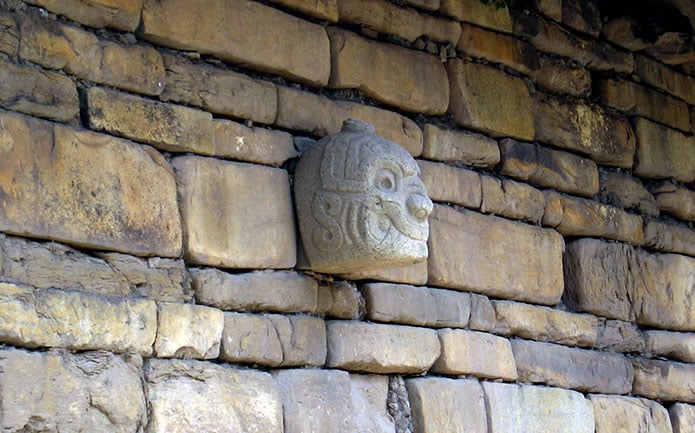
THE CASTILLO (New Temple) has a portal with two columns, and its outer walls were once decorated with tenon heads, carved stone heads set into the walls. It measures about 70 by 72 meters and is about 10 meters high, built of stone and mud, with a maze of internal galleries. Its famous Black and White Portal is built of white granite and black limestone. Only one tenon head remains in its original place, on the west side.
The Old Temple and the Lanzón: the U-shaped Old Temple, as John Rowe called it (1962), faces the Circular Plaza. Deep inside its galleries stands the Lanzón, a carved granite monolith about 4.5 meters tall representing the main deity of Chavín, still in its original place.
The galleries and platforms may have represented duality: day and night, symbolized by birds and felines.
Federico Kauffmann Doig argued that there was no separate Old and New Temple, but that the whole complex was planned as a single unit.
Advertisement