
The Paracas Culture
This culture flourished between about 900 BC and AD 200, at the same time as the Chavín culture, which strongly influenced its art. It was centered in the Pisco and Chincha valleys and on the Paracas Peninsula.
Its development can be divided into two periods:
1. PARACAS CAVERNAS
One representative site of this period is Karwa, where textiles with Chavín-style designs have been found.
Another is Cerro Colorado on the Paracas Peninsula, where collective tombs were found holding up to a dozen funerary bundles each. Each bundle contained a mummy in a squatting position wrapped in cloth, some plain and others luxurious. In family burial chambers, the bundle of the most important person could weigh around 200 kilograms.
Trepanation. Many skulls show this practice of skull surgery, and the evidence shows that many people survived the operation. It was performed with sharp obsidian tools, probably to treat head wounds and also for magical or religious reasons.
2. PARACAS NECRÓPOLIS
This period is famous for its large cloths with polychrome figures that wrapped the mummies. The mantles were made of cotton and embroidered with camelid wool dyed in many colors. They were used during the person’s life and later became their shrouds.
In 1925, Toribio Mejía Xesspe located the burial site, and two years later he and Julio C. Tello excavated the cemetery of Wari Kayan on the slopes of Cerro Colorado, on the Paracas Peninsula, uncovering 429 funerary bundles, large and small.
The mummies survived thanks to the extremely dry climate. The most characteristic design on the mantles is the flying feline-like being holding a human head in one hand and arrows, plants or other symbols in the other.
Another important feature of this period is cranial deformation: many skulls are elongated or rounded, shaped from infancy with boards and cords. The purpose was probably to show social status, as it was usually done among the upper class.

The Nasca Culture (AD 200-700)
It was first studied by the German archaeologist Max Uhle in 1900-1901. The Nasca were heirs to the Paracas tradition, and developed in the valleys of the Chincha, Ica, Grande and Yauca rivers.
At first the Nasca were communities living along the Río Grande. Later, under Paracas influence, they began to depict their gods on textiles and pottery. Their main center was Cahuachi, which covered some 24 km².
Cahuachi lies south of the present-day town of Nasca. It is made up of more than a hundred stepped adobe platforms, including a great pyramid 20 meters high. The finds and the architecture led Helaine Silverman to suggest that each complex was built and maintained by a kinship community, or ayllu.
When Cahuachi was abandoned, the main center moved to Estaquería, named after the many rows of huarango wood posts set in the ground, which probably supported roofs. Here the Nasca traded with the Huarpa culture of Ayacucho. Around AD 700 the Nasca culture went into decline.
The Nasca had to cope with the desert and the scarcity of water, so they built underground aqueducts, or puquios, to tap the groundwater. These channels fed interconnected reservoirs and irrigation ditches that carried water to the fields; some are still in use today.
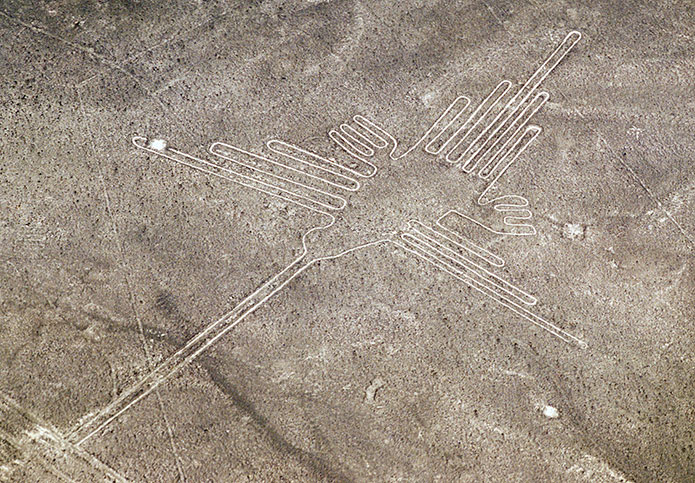
Nasca pottery is varied and of very high quality. Its classic form is a globular jar with two vertical spouts joined by a bridge handle, painted with a brush. Some pieces have up to 11 different colors. Among the beings depicted are felines, the killer whale, the falcon, the hummingbird and other birds with human features. The Nasca are also famous for the giant geoglyphs known as the Nasca Lines.
Advertisement