
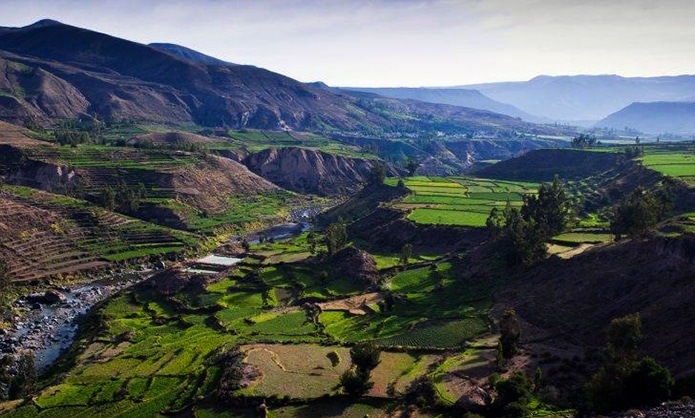
The Colca Valley begins near the town of Chivay and runs northwest for more than 60 kilometers to the Cruz del Cóndor viewpoint, near Cabanaconde. From there the valley narrows into the Colca Canyon, which is some 3,400 meters deep, one of the deepest in the world.
Its walls rise from the river to snow peaks of more than 5,000 meters, and the canyon continues downstream until the river flows into the Majes Valley. The river has three names along its course: Colca in the highlands, Majes in the middle section and Camaná in the coastal desert, just before it reaches the Pacific.
According to the chroniclers, the valley was home to two ethnic groups:
The Collaguas, who claimed to be children of the Collaguata volcano and to have come from inside it. They shaped their children’s heads into a tall, pointed form, imitating the volcanic cone they regarded as their guardian apu. Their language was Aymara.
The Cabanas, who claimed to come from the depths of the snow-capped Hualca Hualca. They flattened their heads to imitate the silhouette of their sacred mountain. They spoke a form of Quechua.
The people of the valley developed techniques to make the most of the water for farming, and the valley is famous for its vast pre-Inca terraces, still in use today.
There are 14 traditional villages in the valley. One road from Chivay runs along the north bank, through Coporaque, Ichupampa, Lari and Madrigal. The other follows the south bank through Yanque, Achoma, Maca, Pinchollo and the Cruz del Cóndor to Cabanaconde, a route of about 60 km. Beyond, trails lead down into the canyon to villages such as Tapay and the oasis of Sangalle.
The undisputed star of the Colca Canyon is the Andean condor, which can be seen soaring over the canyon from the Cruz del Cóndor viewpoint, usually in the morning.
Advertisement