
THE CATHEDRAL
The first cathedral was designed in the 17th century by Andrés de Espinoza and built between 1621 and 1656 of stone and sillar, with brick Gothic vaults. Damaged by fire and earthquakes, the present building was largely rebuilt in the 19th century.
Its façade, flanked by tall towers, is Neo-Renaissance and occupies an entire side of the Plaza de Armas. Inside, it is admired for its brightness. Highlights include the Carrara marble main altar, the choir stalls, the sacristy, the organ and its carved wooden pulpit.
LA COMPAÑÍA
This is the oldest church built of sillar. The first, small building, by Gaspar Báez in 1578, was destroyed by the earthquake of 1584. The second was begun in 1595 and was interrupted several times; the domes were completed in 1690, and it was finally inaugurated in 1698, the date carved on its portal.
Its façade is a masterpiece of Mestizo Baroque carving. The tympanum of the side portal shows a relief of Saint James the Moor-slayer, to whom the church is dedicated, with his body in profile and his head facing forward. Beneath him, two winged mermaids recline as guardians.
The present tower was rebuilt in the 19th century.
Inside, the highlights are the Baroque main altar and the San Ignacio chapel, whose dome is covered with paintings of tropical plants and birds in red and gold.
SAN AGUSTÍN
The church stands on the corner of San Agustín and Sucre streets. Its present building dates from the 19th century: after the earthquake of 1868 it was rebuilt in its original 17th-century Mestizo Baroque style.
SANTO DOMINGO
Two earthquakes destroyed the first church. The façade and the main nave were completed in 1647, and the polygonal tower was built in 1649 by Juan de Aldana.
Its side portal is carved with vines and rosettes, cantuta flowers and trumpeting angels surrounding the image of Saint Dominic.
It was almost completely destroyed by the earthquakes of 1958 and 1960; the side portal and the tower survived and were restored. On the column at the corner, a small replica of the façade has been placed with its doors open, which is why people say this church “never closes its doors”.
SAN FRANCISCO AND THE THIRD ORDER
The earthquake of 1687 damaged much of the church, which had been built in 1569. It was remodeled and enlarged using sillar. Its stone choir and the brickwork of its façade stand out.
The convent has a library of more than 20,000 books and a fine collection of paintings.
Beside it is the small church of the Third Order, built in 1775 and rebuilt after the earthquake of 1784. It has a Latin-cross plan with a dome over the crossing. Its portal shows Mestizo carvings, with Saint Francis and Saint Clare adoring the Host.
LA MERCED
The convent dates from the early colonial period, and the church was built in 1607. The image of Our Lady of Mercy is carved in sillar on the side door. Its main altarpiece is Churrigueresque.
SANTA ROSA
The monastery was founded on June 12, 1747, by order of Bishop Juan Bravo de Rivero, who chose four nuns from Santa Catalina as its founders. The church has a single nave, with a vault supported by pilasters and Mestizo carvings.
LA RECOLETA
This Franciscan convent was founded in 1648, across the Chili River. Its façade has a clock high on the tower and an image of the Virgin in a grotto above the main doorway.
It has four cloisters: the Portería, the Alcantarino, San Francisco and the Missions cloister, which houses a museum about the Franciscan missions in the Amazon, as well as a remarkable old library.
THE SANTA CATALINA MONASTERY
Its main entrance is at Calle Santa Catalina 301. It was founded for cloistered nuns on October 2, 1580, dedicated to Saint Catherine of Siena. It covers an area of more than 20,000 m², like a small city within the city.
It was built thanks to a Spanish widow, María de Guzmán, who decided to become a nun and devote her fortune to the convent, and was named its prioress.
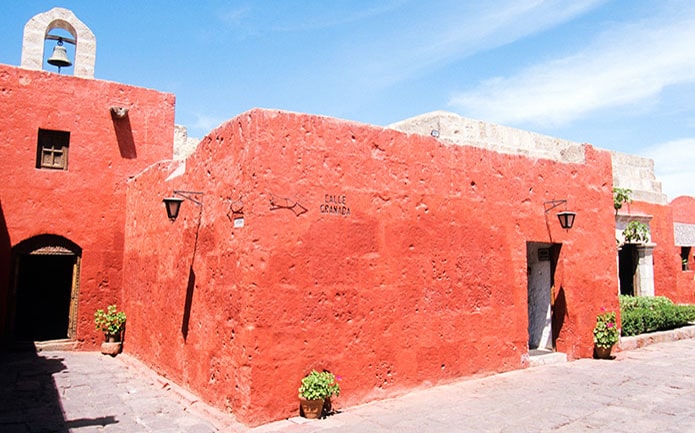
Inside, the monastery is a labyrinth of colorful streets named after Spanish cities such as Seville, Granada, Málaga and Toledo, with cloisters, chapels and the nuns’ small houses. It is divided into two large areas, the “old convent” and the “new convent”.
It was completely closed to the outside world until 1970, when it opened to visitors; a small community of nuns still lives in one part of it.
Advertisement