
Andahuaylillas is a village in the province of Quispicanchi, 44 kilometers from Cusco.
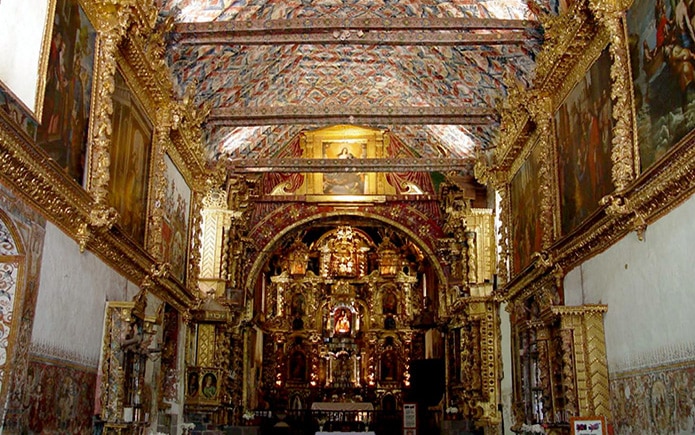
The village is famous for its church, known as the “Sistine Chapel of the Americas” because of its magnificent murals. The church was possibly built on top of an ancient Inca temple. It was dedicated to Saint Peter and has a single nave.
Its façade is very simple. Above the entrance there is a wooden balcony that was probably used as an open chapel for displaying relics or for preaching.
Inside the church there is an inscription written in five languages, Puquina, Latin, Quechua, Spanish and Aymara: “I baptize you in the name of the Father, and of the Son, and of the Holy Spirit. Amen.” It dates from the early 17th century.
The interior decoration is astonishing, especially the beautiful Mudéjar coffered ceiling covered in gold leaf. The canvases have frames that are also covered in gold leaf. Most of the paintings and murals were made by Luis de Riaño, a painter from Lima and a disciple of Angelino Medoro. His surviving works include “The Crucifixion”, “The Baptism of Christ” and “The Archangel Saint Michael”.
The series of eight canvases showing scenes from the life of the Apostle Peter, by an anonymous artist, is later than Riaño’s work, possibly from the second half of the 17th century.
From the same period are the murals of the “Road to Heaven” and the “Road to Hell”, painted on the wall beneath the choir loft. They illustrate the biblical teaching that souls who have followed the narrow, thorny path in life are rewarded with heaven; below this mural is the Psalm about the blessedness of those who have been forgiven. On the other side of the wall is the “Road to Hell”, meaning that those who lived the broad, easy and flowery path on earth will have hell as their eternal home. Below this scene is the Psalm about idolatry. The program may have been inspired by engravings by the Flemish artist Wierix.
The church organ dates from 1610 and is considered the oldest in the Americas.
Advertisement


