
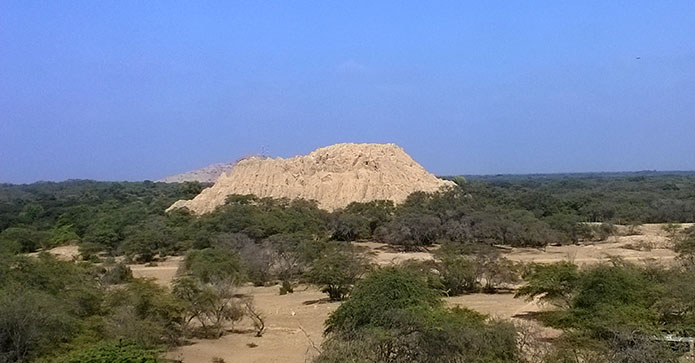
Batán Grande was the political and religious capital of the Lambayeque or Sicán culture between AD 700 and 1100. It is made up of more than thirty temples or platforms. Its name comes from the large number of flat, round stones (batanes) found here, which were used at the time to grind minerals. It was not a large population center; few people lived in the city, and the craftsmen probably lived nearby, at places such as Huaca Arena.
The project began in 1978 under the direction of the Japanese archaeologist Izumi Shimada. No archaeological work had been done before, because the land belonged to a hacienda; the situation changed when the owners were dispossessed in 1969 under the agrarian reform law.
A large number of ornaments have been found made of a type of bronze known as arsenical copper, an alloy of copper with 2% to 6% arsenic. Carob-wood charcoal was used as fuel. Small plates of arsenical copper known as “naipes” have also been found, which may have been used as currency by specialized traders.
The temples were built with adobe bricks and fill of various materials, and more than 90% of the bricks bear makers’ marks. Batán Grande was burned, but only its main buildings (AD 1050-1100). This seems to have happened after a long drought of 30 years, which weakened the power of the Sicán lords; the capital was then moved to Túcume.
HUACA LORO
It was excavated between October 1991 and March 1992. It measures about 80 meters on each side at its base and is more than 35 meters high. The excavation of the East Tomb revealed an important figure buried 12 meters deep. Around the burial chamber there were 7 niches on its four sides, whose floors were covered with sheets of “tumbaga” (an alloy of copper and gold, or copper, gold and silver). In total, 300 kg of tumbaga were found, along with 2 silver-alloy tumis (ceremonial knives), 6 tumbaga masks and necklaces of sodalite, amber, spondylus, amethyst and quartz. Some 20,000 arsenical copper naipes were also found.
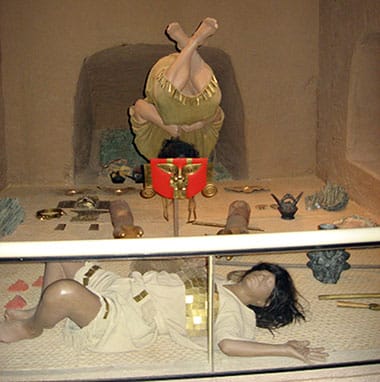
The main figure was found upside down, with his face looking west. He was between 40 and 45 years old and about 1.60 m tall. His body was covered with cinnabar (mercury sulfide). His skull was flattened, possibly because as a child it had been bound to a flat board. He was not left-handed, yet the cup he was buried with was placed in his left hand. His head had been separated from his body and turned nearly 180 degrees, and his face was covered with a mask made from a single sheet of 14-karat gold (52% gold, 31% silver and 17% copper).
Other jewels of the Lord were two gold leg ornaments, six pairs of gold ear spools, a headdress ornament in the shape of a bat’s head and two gold-alloy nose ornaments.
The Lord was buried with two young women of about 20: one seated facing the other, who lay with her legs apart and was of higher rank. A seated child aged 10 to 12 was also buried with him. The Lord’s chamber held 489 pieces of arsenical copper weighing almost 200 kg, many spondylus and conus shells, his wooden litter and a deposit of gold with 14 gold disks (30 cm in diameter) and many gold headdresses. The tomb probably had a wooden roof, as at Sipán, covered with adobe fill.
The West Tomb was excavated in 1995. It contained the burials of 23 sacrificed young women. According to DNA studies they belonged to four different groups and were closely related, as sisters or cousins.
The main figure was buried seated, facing west. He wore a gilded mask and two gilded metal gloves, and a gilded cup was placed in his right hand. This Lord was probably the grandson or nephew of the figure in the East Tomb.
Advertisement

