
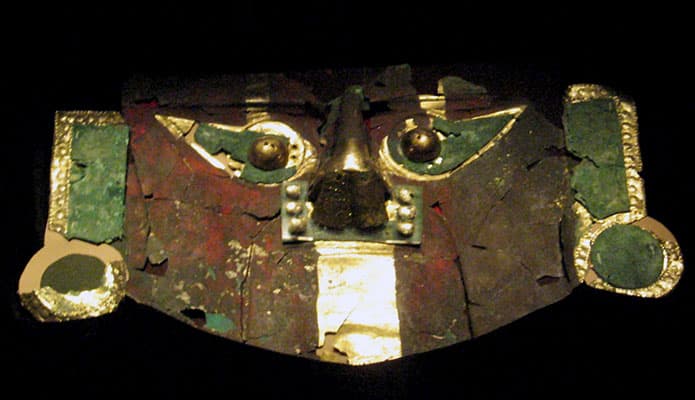
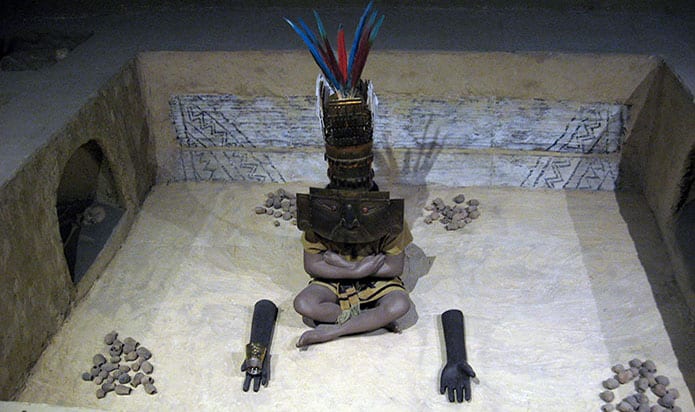
The main center of the Lambayeque culture was the Lambayeque region, but its territory stretched from the Chicama Valley to the Piura area. It began as the Moche culture declined and ended with the Chimú conquest around 1375. The Sicán Archaeological Project, directed by the Japanese archaeologist Izumi Shimada, has divided the development of the Lambayeque or Sicán culture into the following periods:
Early Sicán: AD 700 – 900
Middle Sicán: AD 900 – 1100
Late Sicán: AD 1100 – 1375
In their early years the Lambayeque had no capital, although Huaca Chotuna is considered an important religious center. According to the legend of Naylamp, this is probably where the idol Yampallec (the figure or statue of Naylamp) was placed. The first great capital was Batán Grande, in the La Leche Valley, studied by Izumi Shimada since 1978. The second capital was Túcume, a ceremonial center of 26 pyramids built entirely of adobe. During this time the Chimú conquered the region, but Túcume was not abandoned; on the contrary, it kept its prestige and role until the arrival of the Spanish.
GOLDSMITHING
The Lambayeque were master goldsmiths who inherited the techniques of their predecessors, the Moche. It is estimated that 90% of the gold objects in the Gold Museum of Peru in Lima come from the Lambayeque region. Besides gold, silver and copper, they also used emeralds, turquoise, amber and seashells such as spondylus, strombus and conus. The great symbol of Peruvian goldsmithing is the “tumi”, or ceremonial knife. The most famous one was found by looters in 1937 at Huaca Las Ventanas, Batán Grande. It was acquired by the National Museum of Archaeology and Anthropology, from which it was stolen and partly destroyed in 1981.
CERAMICS
Lambayeque pottery was not as artistic as Moche pottery. They used molds and preferred red and gray. There are two classic types: one is spherical, with a figure of Naylamp on top ending in a conical spout, known as the “Huaco Rey” (King Vessel); the other is globular, with two conical spouts joined by a bridge handle. At Batán Grande, Izumi Shimada found many ceramic pieces covered with a metallic layer of tumbaga (an alloy of copper and gold, or silver and gold).
Advertisement

