
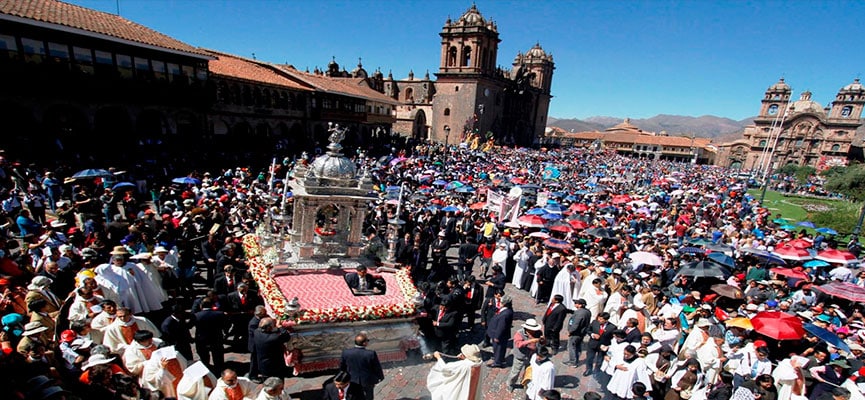
This celebration is dedicated to the Eucharist. It takes place in June, on a movable date. A Papal Bull established it as a major feast in the New World.
In colonial times the festival was warmly received by the indigenous population, as it had many similarities with Inca festivals in which the mummies were carried in procession. During the celebration, saints and virgins are brought from eight colonial parishes to the Cathedral. There are fifteen images in total: Saint Anthony, Saint Jerome, Saint Christopher, Saint Sebastian, Saint Barbara, Saint Anne, the Apostle Saint James, Saint Blaise, Saint Peter, Saint Joseph, the Virgin of the Nativity, the Virgin of Bethlehem, the Immaculate Virgin, the Virgin of the Purification and the Virgin of Los Remedios.
During Corpus Christi, the consecrated Host is carried in procession in a monstrance made of gold and silver, borne by the Archbishop of Cusco.
The celebration can be summarized in three moments:
1) The Entrance: on Wednesday, the images arrive at the Cathedral.
2) The Main Day: the images leave the Cathedral very early and make a procession around the Plaza de Armas. At the end of the procession they return to the Cathedral, where they remain until the following Thursday.
3) The Octave: a farewell procession is held around the Plaza de Armas, usually starting at three in the afternoon. Some images return to their parishes (Saint Anne, Saint Barbara and the Virgin of Los Remedios), while the others go back to the Cathedral to celebrate the “Kacharpari”, the farewell to the Lord of the Earthquakes.
Advertisement


