
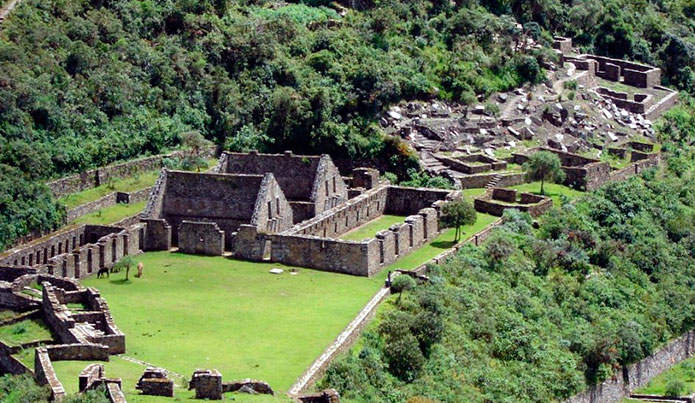
Its name in Quechua means “Cradle of Gold”. It is located in the district of Santa Teresa, province of La Convención, on one of the spurs of the Choquequirao snow peak in the Salcantay range, on the right bank of the Apurímac River at 3,033 m (9,950 ft) above sea level.
Choquequirao was an important Inca city with political and administrative functions. It was built by Pachacutec after defeating the Chancas, with the aim of preventing them from regrouping in the jungles of Vilcabamba.
It was visited between 1834 and 1839 by the French vice-consul in Peru, Léonce Angrand. He believed it was the last refuge of the Incas of Vilcabamba, who resisted the Spanish invaders for forty years.
Unlike Machu Picchu, Choquequirao has no walls made of stones fitted together without mortar. Its buildings were made of stone joined with mud mortar.
Another interesting feature is its nearly 150 terraces, whose retaining walls include white stones arranged to form the silhouettes of llamas.
The city is divided into two sectors:
– Hurin Sector
This sector holds the Ushnu, a ceremonial platform reached by a stairway. Here too is the Pikiwasi, a group of common dwellings with square and circular rooms.
– Hanan Sector
It is made up of ceremonial buildings and the homes of rulers and craftsmen. Choquequirao was connected to other Inca sites by several roads.
A carved stone aqueduct reached the city, bringing water from distant ice-covered mountains.
Advertisement


