
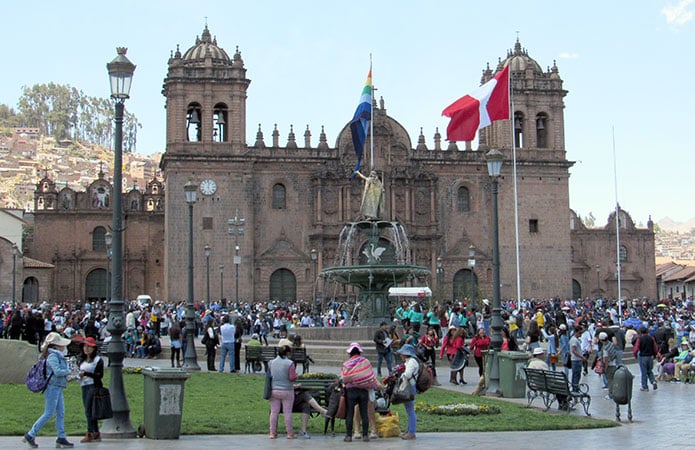
CATHEDRAL
Also a minor basilica. It first stood on the Inca building of Sunturwasi, where the Church of El Triunfo stands today. The seat was later moved to Kiswarkancha, the palace of the Inca Wiracocha.
The cathedral is Renaissance in style and reaches a height of 33 meters. It was built between 1560 and 1668 with stones brought from the quarries of Rumicolca and Sacsayhuaman.
Its patron is the Lord of the Earthquakes (Señor de los Temblores), the sworn patron of Cusco. The interior is divided into five naves. There are eleven chapels, the most important being those of the Virgen de los Remedios, the Virgen de Chokonchaca and the Immaculate Conception, also known as “la Linda de la Catedral” (the Beauty of the Cathedral).
There are more than 300 paintings. Highlights include the Litany of Loreto by Marcos Zapata (1655); the canvases by Basilio Santa Cruz “Saint Isidore the Farmer”, “Saint Christopher” and “Saint Philip Neri”; and “The Imposition of the Chasuble on Saint Ildefonsus” by Diego Quispe Tito. Paintings from the series depicting the Parables of Christ, the Twelve Months of the Year and the Four Seasons are also preserved.
The Gospel tower holds the famous bell called “María Angola”, one of the largest in the world.
LA COMPAÑÍA DE JESÚS
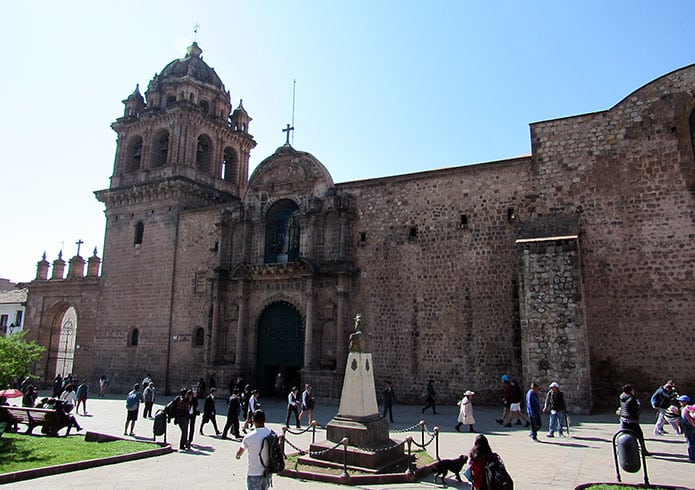
Construction began in 1576 on the site of Amaru Cancha, the palace of the Inca Huayna Capac. The earthquake of 1650 badly damaged the building, so a new church had to be built; it was inaugurated on August 19, 1668. It was designed by Juan Bautista Gilles.
The most important sculptures are those of Saint Jerome, Saint Francis and the Lord of Burgos. Among the paintings, the most notable shows the marriage of Martín García de Loyola and Beatriz Clara Coya.
CHURCH AND CONVENT OF LA MERCED
The present church was built after the earthquake of 1650. It is divided into three naves.
Inside there are Plateresque and Renaissance altarpieces. The crypts here hold the remains of Diego de Almagro the Elder and Diego de Almagro the Younger, as well as those of Gonzalo Pizarro.
The convent has a square plan and two floors. It is built of stone and decorated with a magnificent Mudéjar coffered ceiling.
Outstanding paintings include the Crucified Christ by Francisco de Zurbarán, two Immaculate Conceptions by Bernardo Bitti and the series on Saint Peter Nolasco by Ignacio Chacón.
This is also home to the finest piece of Cusco silverwork, the Monstrance of La Merced. This jewel combines two styles: the upper part is Baroque and was made by the Spanish silversmith Juan de Olmos in 1720; the lower part was made by the Cusco artist Manuel de la Piedra in 1805. It weighs 22.2 kilograms and stands 1.30 meters tall. It is set with 1,500 diamonds, 615 pearls, rubies, topazes and emeralds.
CHURCH AND CONVENT OF SANTA CATALINA
It was founded in 1605 on the site of the Acllahuasi, the House of the Chosen Women (Virgins of the Sun). The church has a single nave.
It preserves beautiful paintings by Juan Espinoza de los Monteros depicting episodes from the life of Saint Catherine of Siena.
CHURCH OF SANTO DOMINGO
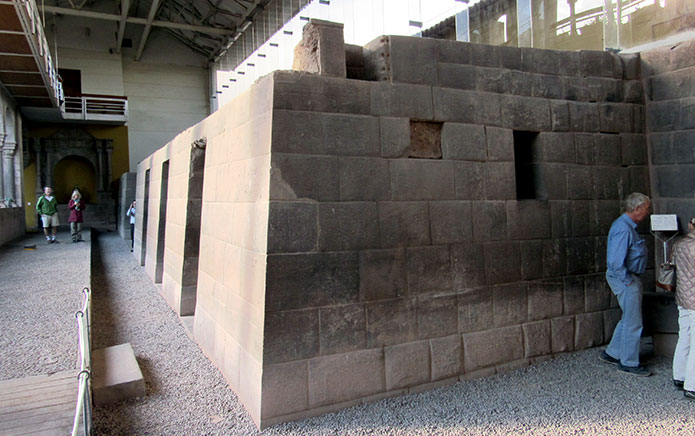
It is built on top of the Inca temple of Coricancha. It was the first church of the Dominican order established in Peru. Some stone walls of the Inca temple have survived within its structure.
It preserves the image of Saint Dominic de Guzmán, carved in 1698 by the indigenous sculptor Melchor Huamán.
The Coricancha – according to the Inca Garcilaso de la Vega, the four walls of the temple were covered with gold plates, and on the main wall there was a large golden disk representing the Sun god. In Inca cosmology, the Coricancha was the center of the world: from here began all the roads that connected it with other sacred sites. The four main roads represented the four parts of the Inca world (the Tahuantinsuyo). It is also said that there was a garden where the plants and animals were made of gold and silver.
PARISH CHURCH OF SAN BLAS
Built in the 16th century, it is the oldest parish church in Cusco. The main altar is Baroque, with three tiers and five vertical sections.
The pulpit is a true masterpiece. Its creator is unknown; legend says it was made by an indigenous man with leprosy who was cured by the Virgin of Buen Suceso and, in gratitude, began carving this work of art. The pulpit depicts the nine Doctors of the Church: Saint Bernard, Saint Basil, Saint Jerome, Saint John Chrysostom, Saint Leo, Saint Augustine, Saint Gregory the Great, Saint Thomas Aquinas and Saint Bonaventure. At the top of the sounding board stands the Apostle Saint Thomas holding a cross. A curious detail is the carving of a skull.
HATUN RUMIYOC STREET
It is one of the streets most visited by tourists. In one of its stone walls, which belonged to the palace of the Inca Roca (today the Archbishop’s Palace), is the “Twelve-Angled Stone”, a symbol of Inca stonework.

Advertisement


